
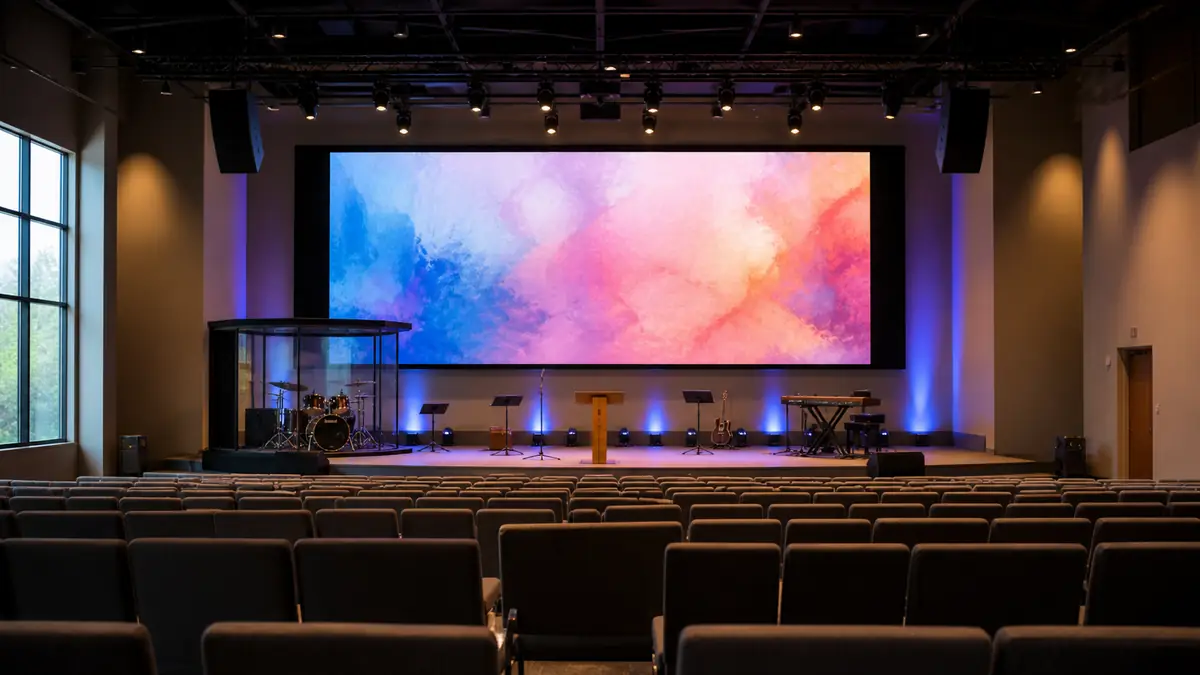
Key Takeaways
- The best church LED screen is sized from the farthest viewer, first row, camera plan, and content type.
- Pixel pitch should follow viewing distance and filming needs, not showroom sharpness.
- Budget planning must include panels, control, structure, power, installation, spares, freight, and support.
- For most indoor church projects, the winning specification is balanced, serviceable, and camera-ready.
The most expensive mistake in a church LED screen project is not choosing a screen that is too small. It is choosing a specification that solves the wrong problem.
Many buyers start with the same question: "Should we choose P2.5, P2.9, or P3.91?" That question matters, but it comes too early. A church screen is not a TV enlarged on a wall. It is a communication system for lyrics, scripture, IMAG, stage backgrounds, livestream cameras, visiting speakers, concerts, conferences, and community events.
That is why this guide takes a manufacturer-side view. The right LED screen for church use should be judged by sightlines, camera behavior, service access, content workflow, and total installed cost. Pixel pitch is one decision inside that system.
What Most Church LED Screen Guides Miss
Most church LED screen guides cover pixel pitch, brightness, installation type, and price ranges. MediaMerge focuses on budget estimation. Church Production explains pixel pitch and camera artifacts. Several manufacturer posts compare projector replacement, small pixel pitch, and sanctuary benefits. Those are useful, but they often treat the church as one simple room.
Real projects are more mixed. A Sunday service may need readable lyrics from the back row. A Friday youth event may use animated backgrounds. A wedding, conference, or concert may put cameras close to the screen. A rental company may need the same cabinets to work in churches, ballrooms, exhibition booths, and school auditoriums.
The better angle is this: do not buy the smallest pixel pitch you can afford. Buy the coarsest pitch that still meets the room, camera, and content requirements with room for long-term reliability.
That view protects the budget without lowering the result. It also keeps the screen easier to service, easier to power, and easier to expand later.
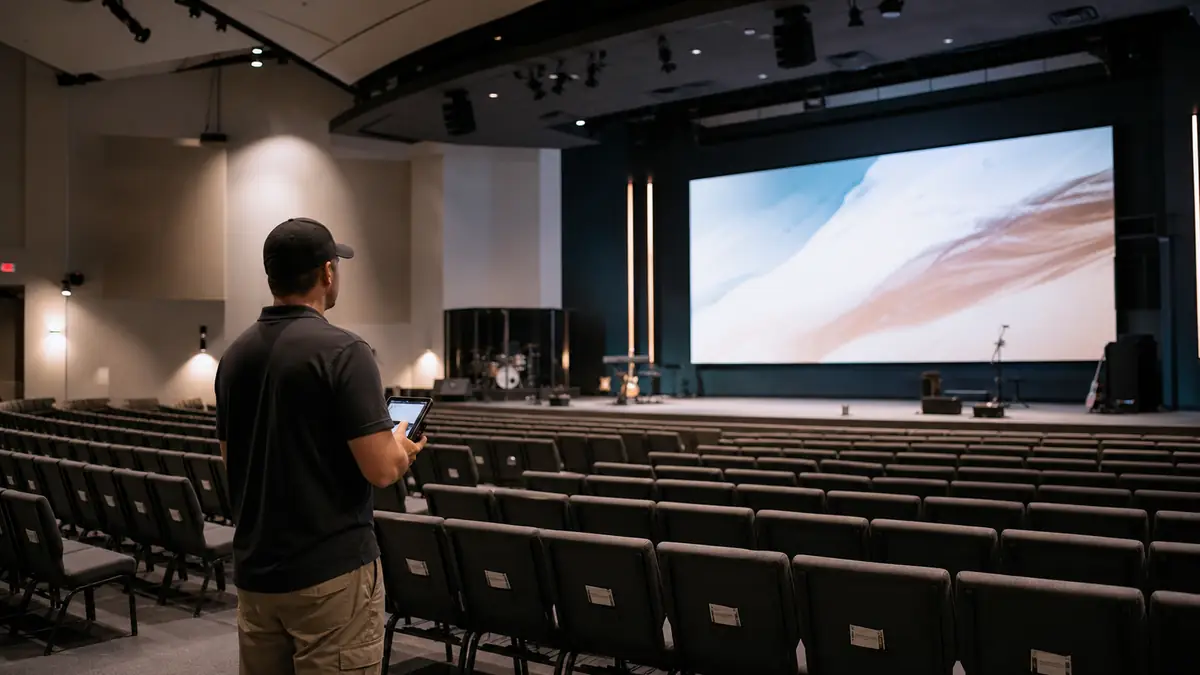
How Should You Choose Pixel Pitch for a Church LED Screen?
Pixel pitch should be chosen from the nearest viewer and the nearest camera position. Church Production gives a simple field rule: about one meter of viewing distance for every millimeter of pixel pitch. That means P3.9 starts to make sense near 3.9 meters, while P2.5 supports closer seating and sharper camera backgrounds (Church Production, 2014).
Pixel pitch is the distance between the centers of two neighboring LED pixels. A lower number means more pixels in the same area. More pixels can improve detail, but they also raise cost, increase module density, and may create a more demanding service plan.
For a church, there are three pitch decisions, not one.
First-row viewing distance
Start with the closest seated viewer who needs to read lyrics or see faces without noticing individual LEDs. If the first row is close to the wall, fine pitch matters. If the first row is far away, buying ultra-fine pitch may spend money the congregation will not see.
As a practical planning range:
| First row distance | Common indoor pitch range | Typical use |
|---|---|---|
| 2 to 3 m | P1.5 to P2.5 | Small chapel, close seating, premium broadcast backdrop |
| 3 to 5 m | P2.5 to P3.0 | Main sanctuary, lyrics, sermon slides, IMAG |
| 5 to 8 m | P3.0 to P4.0 | Medium to large sanctuary, stage background |
| 8 m+ | P4.0 and above | Large halls, secondary screens, far-view scenic use |
These are planning ranges, not a substitute for drawings. A fan-shaped sanctuary with side seating can require a different choice from a narrow rectangular hall.
For a deeper technical explanation, compare this section with our LED display pixel pitch guide.
Camera distance and moire risk
If the LED wall appears behind the pastor, worship team, keynote speaker, or product presenter, camera distance matters as much as seat distance. Church Production notes that moire, banding, and other camera artifacts can appear when the subject is close to the LED wall and the wall remains in focus (Church Production, 2026).
This is where many budget screens fail. They look acceptable to the eye but unstable on livestream. The fix is not always "buy the smallest pitch." You also need:
- High refresh rate for camera capture
- Good low-brightness grayscale
- Proper calibration
- Reasonable subject-to-wall distance
- Content that avoids dense fine-line patterns
- Camera tests before final approval
If broadcast quality is part of the project, request a camera test with the actual camera body, lens range, shutter settings, and stage lighting plan.
Content type
Lyrics and scripture need readability. IMAG needs face detail. Scenic backgrounds need color depth and smooth dimming. Sponsor loops for conferences need brand consistency. Training rooms need text clarity.
That means a church screen used only for lyrics can accept a different pitch than a church screen used as a full broadcast background. For commercial buyers, the same logic applies to retail launches, government briefings, stadium sponsor zones, hotel ballrooms, and exhibition stages.
How Big Should a Church LED Screen Be?
Screen size should be calculated from the farthest viewer and the smallest critical content. AVIXA's Display Image Size for 2D Content in Audiovisual Systems, known as DISCAS, exists because unreadable screens are a common AV failure. The calculator asks what kind of viewing takes place and sizes the display from that use case (AVIXA, 2026).
For church use, do not begin with cabinet count. Begin with the job the screen must do.
Use the farthest viewer for height
If people in the back row must read song lyrics, scripture, schedules, or teaching notes, screen height becomes the controlling factor. A wide screen that is too short may look impressive in photos but still fail the person seated at the rear.
As a practical brief, collect:
- Farthest viewer distance
- Closest viewer distance
- Ceiling height and stage trim height
- Width between speakers, columns, curtains, or acoustic panels
- Main content types: lyrics, IMAG, slides, scenic backgrounds, sponsor loops
- Whether side screens will stay or disappear
Once you know the height, the width follows the content format.
Choose aspect ratio by content, not habit
A 16:9 wall is usually easiest for IMAG, sermon slides, livestream confidence feeds, and common media templates. A wider wall can create a stronger stage backdrop, but it may need custom content and careful composition so text does not stretch awkwardly.
For touring events and rental inventory, standard cabinet geometry matters. Rental panels often use 500 x 500 mm or 500 x 1000 mm cabinets because those sizes pack well, rig quickly, and scale across many stage dimensions. For fixed indoor church installs, 320 x 160 mm module-based systems can help build a smoother high-definition canvas. You can compare relevant fixed options such as HD small pixel pitch indoor LED screens and COB fine pitch indoor LED screens.
Do not forget side seats
Side seating changes everything. A screen that looks excellent from the center aisle can lose contrast from steep angles. Before approval, check the leftmost, rightmost, balcony, and rear positions. If the room is wide, secondary displays may serve the congregation better than one oversized central wall.
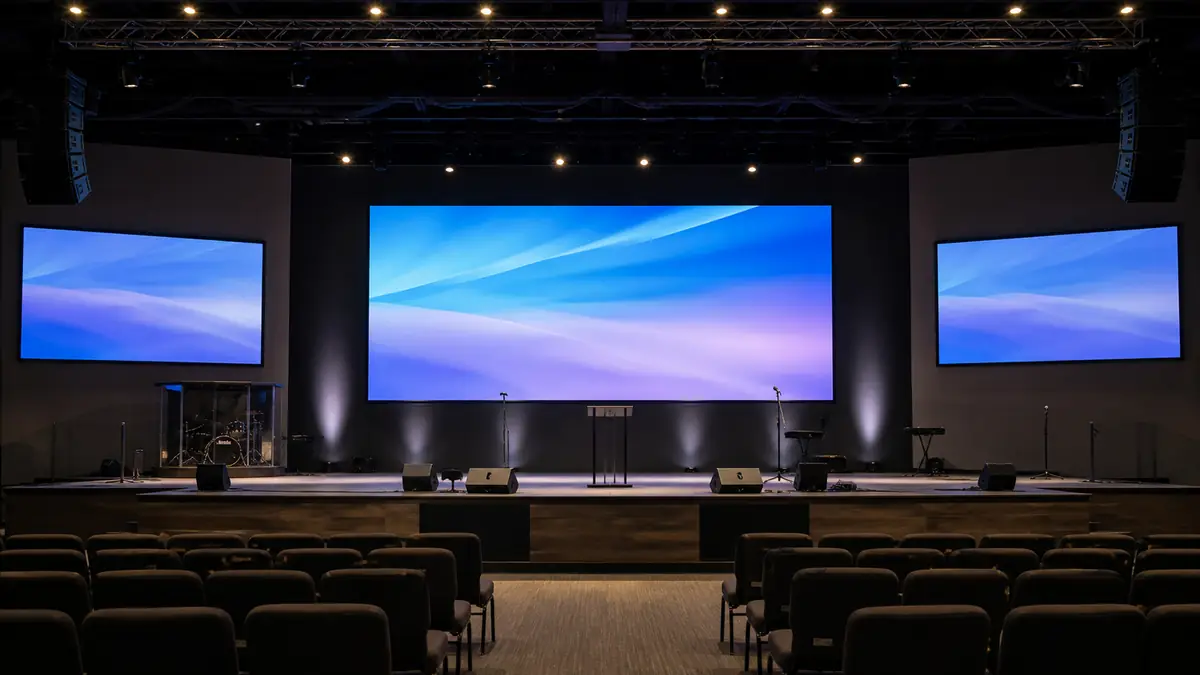
What Should a Church LED Screen Budget Include?
A realistic church LED screen budget includes the display system, not just the LED panels. Many online guides list broad project ranges, but the better planning method is to split the quote into hardware, control, structure, power, installation, logistics, and after-sales support.
Here is the budget model professional buyers should use before asking suppliers for prices.
| Budget line | What it includes | Why it changes the quote |
|---|---|---|
| LED panels or cabinets | Modules, cabinets, receiving cards, power supplies | Size, pitch, packaging, cabinet material, refresh rate |
| Video processing | Processor, scaler, sender, backup signal path | IMAG, multi-source input, livestream, split screens |
| Structure and mounting | Wall frame, hanging system, ground support, service access | Building conditions, weight, safety margin |
| Power and data | Distribution, cables, grounding, network route | Screen size, local code, redundancy |
| Installation labor | Assembly, alignment, calibration, testing | Height, access, rigging, schedule limits |
| Spares and tools | Spare modules, receiving cards, power supplies, masks | Downtime tolerance and long-term service plan |
| Freight and packaging | Flight cases, crates, customs, insurance | Project country, cabinet type, delivery speed |
| Support and warranty | Documentation, remote help, replacement policy | Supplier maturity and parts continuity |
The biggest price driver is usually screen area. The second is pixel pitch. The third is project complexity. A simple flat wall with front service access is not the same budget as a curved backdrop, flown rental wall, outdoor IP-rated screen, or stage set with camera-critical requirements.
For a fuller cost breakdown, read our LED video wall cost guide.
Budget by project type
The following bands are not universal quotes. They are decision categories that help teams avoid comparing mismatched offers.
| Project type | Typical priority | Budget risk to watch |
|---|---|---|
| Small chapel or training room | Fine pitch, text readability, quiet operation | Overbuying pitch but underbuying service access |
| Mid-size sanctuary | Balanced pitch, 16:9 content, reliable control | Ignoring structure, power, and calibration |
| Broadcast-focused worship stage | Camera performance, grayscale, refresh rate | Buying by eye test only, then seeing moire on stream |
| Event and rental inventory | Fast locks, weight, cases, repair speed | Choosing fixed-install cabinets for touring use |
| Outdoor church plaza or public event | Brightness, IP rating, wind, heat, service | Comparing indoor prices with outdoor requirements |
For AV rental companies and event suppliers, rental LED display panels and rental LED screen manufacturer sourcing are different buying paths from a fixed sanctuary wall.
Which Technical Specs Matter After Pixel Pitch?
Pixel pitch may win the first meeting, but refresh rate, grayscale, brightness control, cabinet design, and service access decide whether the wall still looks good after installation. Christie describes LED video walls as unique installations that need design flexibility, reliability, and support, not only resolution (Christie Digital, 2026).
For a church project, the most important secondary specs are practical.
Brightness and dimming range
Indoor church LED screens often run far below their maximum brightness. A screen that is too bright can wash faces, fight stage lighting, and distract the room. The key is not the highest nit number. The key is clean grayscale and color at low brightness.
Ask how the wall behaves at 10%, 20%, and 30% brightness. Check skin tones on camera. Check white lyrics on black backgrounds. Check dark worship backgrounds with slow gradients.
Refresh rate and scan design
If the wall is filmed, ask for high refresh rate and camera-safe performance. Also ask about scan ratio, driver ICs, grayscale, and calibration. A high refresh number alone does not guarantee a clean camera image, but a low-performance electronics package can create visible flicker and bands.
Front service or rear service
Many churches want the LED screen close to a back wall. In that case, front service is often worth paying for. Rear-service designs need space behind the wall, which may not exist in a shallow stage or renovated sanctuary.
For outdoor or wall-mounted public displays, a front service outdoor LED screen can reduce maintenance access problems.
Packaging: SMD, GOB, or COB
SMD is common and cost-effective. GOB adds surface protection for rental or high-touch environments. COB can improve durability and visual smoothness for fine-pitch indoor projects. The right choice depends on pitch, budget, touch risk, repair preference, and viewing distance.
In churches with volunteers, school use, multipurpose halls, or rental turnover, durability can be more valuable than chasing a slightly smaller pitch.
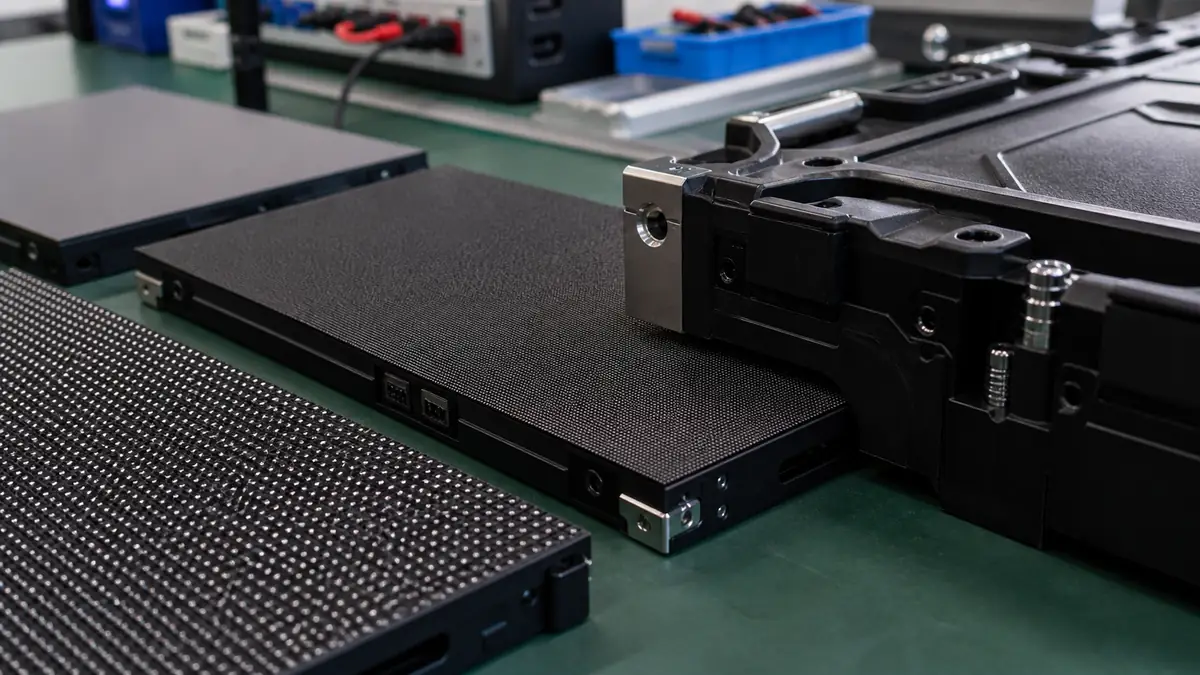
Should You Buy a Fixed LED Wall or Rental LED Panels?
A fixed wall is best when the church needs a permanent, clean, serviceable screen. Rental panels are better when the buyer needs mobility, inventory reuse, quick setup, and repeated transport. The two systems may look similar in photos, but they are built for different operating lives.
Choose a fixed wall when:
- The display stays in one sanctuary or auditorium
- The mounting surface is stable
- The screen should look architectural
- Front service matters
- Content size will stay consistent
Choose rental panels when:
- The same screen must serve church events, concerts, exhibitions, hotels, and training rooms
- Panels need flight cases
- Fast locks and corner protection matter
- Crews install and remove the wall often
- Curving, stacking, or hanging changes by project
This distinction matters for advertising media companies, event companies, and venue operators. A church may be one project type, but your inventory may also serve brand launches, government ceremonies, sports activations, hotel ballrooms, and corporate training events. For that buyer, cabinet strength, spare parts, and repeated assembly speed can be more important than a showroom-perfect specification.
Explore broader application paths on our LED display markets page and review real installation variety in our LED display case studies.
What Should Professional Buyers Ask Before Requesting a Quote?
A strong quote request should describe the room, content, installation, and support expectations. If a supplier can quote only from width, height, and pixel pitch, the quote may miss the conditions that decide performance.
Send these details to the manufacturer:
- Venue type and seating capacity
- Farthest viewer and closest viewer distances
- Desired screen width and height, or available wall space
- Main content: lyrics, IMAG, slides, scenic, sponsor ads, training materials
- Camera plan: livestream, broadcast, close-up subjects, camera distance
- Indoor or outdoor environment
- Fixed installation or rental use
- Mounting condition: wall, flown, ground support, truss, curved structure
- Front or rear service preference
- Local voltage, power route, and cable route
- Required delivery timeline
- Spare parts and warranty expectations
As a Shenzhen LED display manufacturer, LED Visual supports OEM and ODM projects across multiple product lines, with global project experience and after-sales support. That manufacturing background helps buyers compare more than headline price: cabinet design, module continuity, control compatibility, packaging, spare parts, and service workflow all affect the real cost of ownership.
If you already have drawings, photos, or a room size, send them through the contact page or review the support page before finalizing your technical brief.

The Manufacturer's Opinion: Balanced Specs Beat Extreme Specs
The best church LED screen projects usually do not come from the most aggressive specification. They come from a balanced decision: enough resolution for the room, enough brightness control for worship lighting, enough refresh performance for cameras, enough structure for safety, and enough spare parts for long-term service.
That balance matters because churches are not only worship spaces. Many now operate as broadcast studios, conference venues, training rooms, community theaters, schools, and event spaces. The same screen may support a Sunday sermon, a government town hall, a retail brand night, a graduation ceremony, and a paid concert.
So the question is not, "What is the best pixel pitch?"
The better question is, "What is the lowest-risk screen system for this room, content plan, camera plan, and budget?"
When you answer that question, the right pixel pitch becomes much easier to choose.
FAQ
Is P2.5 always better than P3.91 for a church LED screen?
No. P2.5 gives higher pixel density, but P3.91 may be the smarter choice when viewers sit farther away, the wall is mainly scenic, or budget must cover structure and control quality. Choose by distance, camera needs, and content detail.
What is the best screen size for a church sanctuary?
The best size depends on farthest viewer distance, content type, ceiling height, and stage width. A 16:9 wall works well for IMAG and slides, while a wider wall can work better as a scenic backdrop. Use AVIXA DISCAS-style thinking before cabinet counts.
How much should churches budget beyond LED panels?
Plan for control, mounting, power, cables, installation, calibration, spares, freight, and support. Panels are only one part of the system. A low panel price can become expensive if the quote excludes structure, power, spare modules, or camera testing.
Are LED screens better than projectors for churches?
LED screens usually handle ambient light better and can give higher contrast for lyrics, IMAG, and stage visuals. Projectors can still work in darker rooms or smaller budgets. The choice depends on lighting, screen size, content, maintenance, and camera plans.
Should a church choose COB LED?
COB can be a good choice for fine-pitch indoor screens that need stronger surface protection and smooth close viewing. It is not automatically required for every church. Compare COB, GOB, and SMD by pitch, viewing distance, touch risk, and repair preference.
Final Takeaway
A church LED screen should make the message easier to see, not make the technology the center of attention. Choose the screen from the room outward: viewers first, cameras second, content third, budget always.
If you are planning a church, event, retail, stadium, hotel, government, or education LED screen project, prepare the room dimensions, viewing distances, content plan, and camera requirements. Then ask for a system-level quote that explains the tradeoffs clearly.
Request a factory-direct LED screen proposal and include your drawings, photos, target size, and expected use cases.