
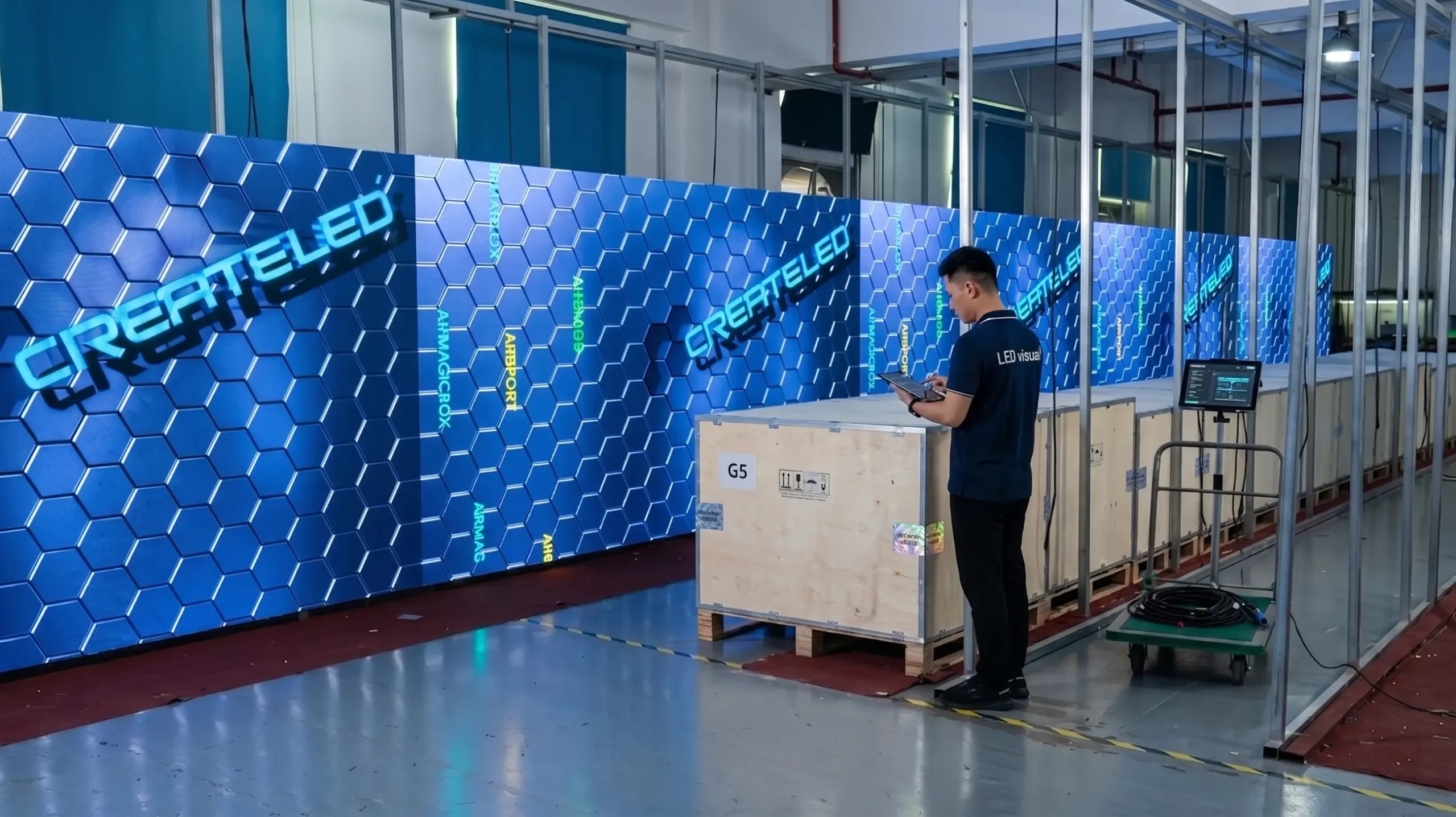
Importing an LED screen is not mainly a price-comparison exercise. It is a risk-control exercise.
Two suppliers can quote the same pixel pitch, cabinet size, brightness, and refresh rate while offering very different products. The difference may be hidden in the LED binning, driver IC, power supply, cabinet tolerances, calibration process, waterproofing details, spare-parts policy, or the way defects are handled after delivery.
The factory that wins your order should be able to show evidence for every important promise.
This is the checklist we recommend to importers, AV integrators, advertising companies, event production firms, retailers, public institutions, sports venues, hotels, and education buyers. It is based on a simple position: audit the manufacturer's process and evidence chain, not just the showroom screen.
Quick answer: Before placing an order, verify seven areas: legal identity, engineering capability, component control, production process, testing and calibration, destination-market compliance, and after-sales responsibility. A factory is ready for serious export work when it can connect your written specification to traceable materials, controlled assembly, documented testing, and a clear service plan.
What competing factory-checklist articles get right—and what they miss
Most factory-audit guides correctly tell buyers to inspect the production line, quality system, certificates, raw materials, export documents, and final inspection. They also warn importers not to confuse a trading company with a manufacturer.
Those are necessary checks, but they are not sufficient for an LED display project.
The common weakness is that the checklist stops at observation: Does the factory have an SMT line? Does the supplier show a certificate? Does the sample look bright? A stronger audit asks what happens when the project is customized, when a component changes, when modules from different batches are mixed, or when a replacement is needed two years later.
An LED screen is a system, not a panel. Your audit should therefore follow the system lifecycle:
- Define the application and performance requirement.
- Map each requirement to a component and manufacturing step.
- Verify how the factory tests and records the result.
- Confirm what happens after the screen reaches your market.
That is the angle of this guide. A factory tour is useful, but a controlled evidence chain is what protects the importer.
1. Confirm that you are dealing with the actual manufacturer
Start with identity before discussing technical specifications. A supplier that cannot clearly identify the legal entity, factory address, ownership of production equipment, and responsible sales entity creates avoidable commercial risk.
Peça:
- The registered company name and business license.
- The physical production address, not only an office or showroom address.
- A live video tour or on-site visit covering receiving, assembly, testing, storage, and packing.
- The relationship between the contracting company, factory, brand owner, and exporter of record.
- A written statement identifying any outsourced process.
- A sample commercial invoice and packing list with the same legal entity named consistently.
Do not treat a polished website as proof of manufacturing ownership. The useful question is whether the supplier can show where your screens are actually designed, assembled, tested, packed, and supported.
For example, LED Visual presents itself as a Shenzhen manufacturer that handles R&D, production, sales, and maintenance under one roof. Its Página «Sobre nós» describes dedicated quality stations on production lines and raw-material traceability. Those claims should still be tested during qualification: ask to see the relevant records, not just the marketing statement.
Red flags: the bank account belongs to an unrelated company; the factory tour shows only finished goods; the supplier refuses to identify component brands; or every technical question is redirected to a salesperson who cannot involve an engineer.
2. Audit engineering before you audit capacity
Capacity matters only when it is the right capacity for your product.
An importer buying a stadium perimeter display needs a different engineering conversation from a retailer buying a fine-pitch indoor wall. An event production company needs fast assembly, repeatability, spare inventory, and camera-friendly performance. A government or corporate buyer may need documentation, service continuity, and strict procurement compliance.
Before asking “How many square meters can you produce per month?”, ask:
- How is pixel pitch selected for the actual viewing distance?
- How are brightness, refresh rate, scan mode, grayscale, and color uniformity specified?
- Can the cabinet dimensions, service access, structure, power distribution, or control system be adapted?
- What environmental conditions apply at the installation site?
- How are heat dissipation, drainage, wind load, corrosion, and maintenance access addressed?
- Which drawings, BOM versions, wiring diagrams, and installation instructions will be issued for approval?
The manufacturer should be able to turn a project brief into a controlled technical proposal. That proposal should state assumptions. “Outdoor LED screen” is not a complete specification; it should be translated into viewing distance, daylight condition, operating hours, weather exposure, service method, cabinet size, power conditions, and local regulations.
LED Visual groups its solutions by applications such as advertising, rentals and staging, broadcast, and sports. That application focus is valuable because product selection should begin with use case, not with whichever cabinet is already in stock.
3. Check the bill of materials—not just the headline specification
The most important factory document for an importer is often the approved bill of materials. It defines what is inside the screen and what may change without your approval.
Request the proposed BOM for:
- LED package and binning method.
- PCB and module design.
- Driver IC and scan configuration.
- Receiving cards, sending cards, and video processor.
- Power supply brand, model, input range, and derating practice.
- Cabinet material, coating, mask, locks, handles, and connectors.
- Fans, filters, gaskets, cables, and other environmental-control parts.
- Spare modules, receiving cards, power supplies, and special tools.
Then ask which items are approved alternatives and under what conditions a substitution is allowed. A component change may affect brightness, color consistency, power consumption, service compatibility, or compliance status even when the advertised pixel pitch remains unchanged.
Do not accept “same quality” as a technical substitution rule. Require a part number, revision, test evidence, and approval process.
For close-viewing applications such as control rooms, studios, meeting spaces, retail interiors, and corporate lobbies, the importer should pay particular attention to module flatness, color uniformity, low-brightness performance, service access, and camera compatibility. LED Visual's small-pixel-pitch indoor product page illustrates the level of detail a product specification should contain: pixel-pitch options, brightness range, refresh rate, viewing distance, service method, and module format.
4. Inspect the production process from incoming inspection to packing
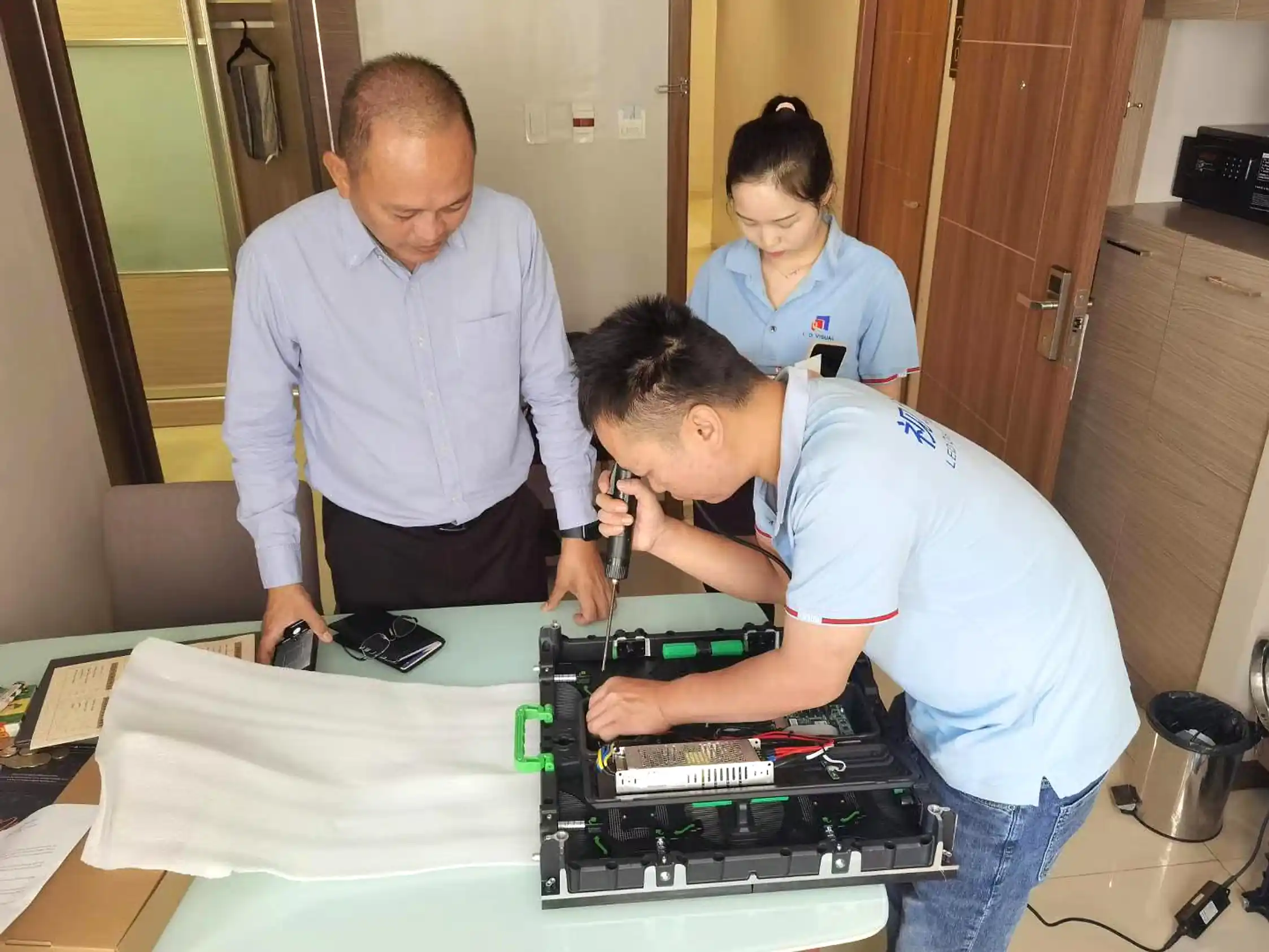
A reliable factory does not rely on final inspection to discover problems created earlier. Quality control should be visible at several points in the process.
Incoming material control
Ask how the factory verifies quantity, model, date code, appearance, and electrical condition when materials arrive. Check whether lots are identified and whether rejected materials are physically separated.
SMT and module assembly
If the factory uses SMT production, ask how placement accuracy, solder quality, polarity, and rework are controlled. If assembly is outsourced, ask which process is outsourced, who owns the specification, and how incoming finished modules are requalified.
Cabinet assembly
Inspect connector fit, cabinet flatness, locking mechanisms, grounding, cable routing, sealing, and service access. A cabinet that looks acceptable on a showroom wall may still be difficult to install repeatedly or repair safely in the field.
Aging and burn-in
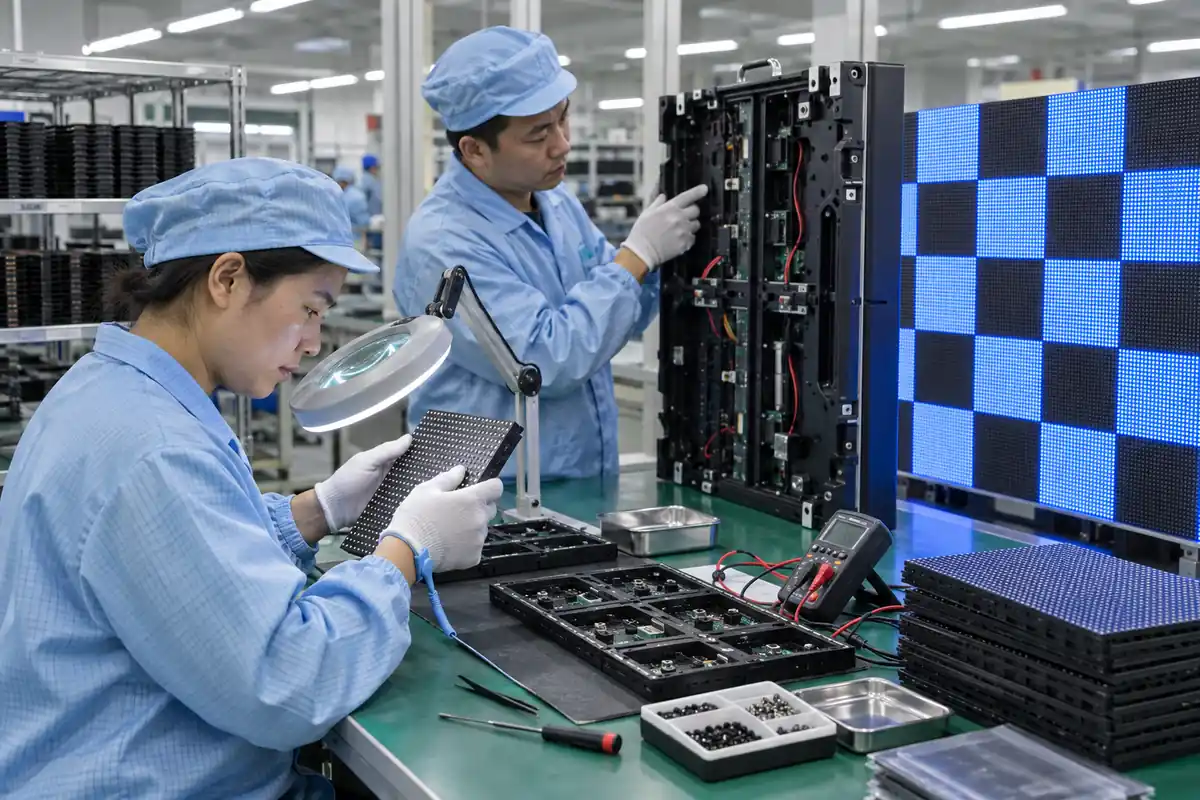
Ask how long complete cabinets or modules are powered before shipment, what test patterns are used, and how failures are recorded. The useful evidence is not a statement such as “we do aging”; it is a work instruction and a completed record tied to the batch.
Final inspection and packing
The factory should verify appearance, dead or abnormal pixels, module alignment, cabinet dimensions, power behavior, signal integrity, brightness, color, accessories, labels, and packing quantity. Photograph or video the approved sample and retain a signed golden-sample record.
At LED Visual, the stated manufacturing approach includes dedicated inspection stations and material traceability. For an importer, the next step is to ask how those controls appear in the order file: lot numbers, inspection records, calibration files, packing records, and nonconformance reports.
5. Verify performance with project-specific tests
Never approve an LED screen from a single visual demonstration. A showroom demonstration is designed to look good; a factory acceptance test is designed to expose risk.
Your test plan should reflect the actual project. At minimum, define acceptance checks for:
- Pixel pitch and cabinet dimensions.
- Brightness at the agreed operating mode.
- Refresh rate and camera performance where filming or broadcasting is involved.
- Grayscale and color reproduction.
- Module-to-module uniformity after calibration.
- Dead, stuck, dim, or discolored pixels.
- Cabinet flatness and visible seam consistency.
- Maximum and typical power consumption.
- Signal redundancy and restart behavior.
- Temperature, humidity, waterproofing, and ingress protection where relevant.
- Front or rear maintenance procedure.
- Accessories, spare parts, labels, and documentation.
For outdoor screens, the IP claim needs careful handling. IP ratings classify degrees of protection provided by enclosures under IEC 60529; they do not by themselves prove that an installed sign will survive every local combination of rain, dust, salt, wind, heat, drainage conditions, and maintenance practice. Ask whether the stated IP rating applies to the front, rear, or complete cabinet, and under what test conditions.
For sports and broadcast projects, a high refresh-rate number is not enough. Confirm the complete signal path, camera test method, scan configuration, processor settings, and whether redundant signal paths are included. LED Visual's stadium perimeter display specification lists brightness, refresh rate, operating temperature, IP protection, viewing distance, power, and service method—exactly the categories that should appear in an order-specific acceptance plan.
6. Check calibration and data continuity
Calibration is where a collection of LED modules becomes a consistent display.
Ask the manufacturer:
- Is calibration performed by module, cabinet, or complete screen?
- What equipment is used, and is it regularly calibrated?
- Are calibration files stored and backed up?
- Can the factory reproduce the original color and brightness settings after a module replacement?
- Are receiving-card parameters and firmware versions recorded?
- How are replacement modules matched to the installed batch?
This matters especially when the screen is large, close-viewed, filmed, or expected to operate for many years. A replacement module that is electrically compatible but visually mismatched can create a visible patch on an otherwise uniform wall.
Your purchase file should preserve the final configuration: approved BOM, cabinet drawings, calibration data, control-system files, firmware versions, factory test report, packing list, and serial-number map. This documentation is not paperwork for its own sake. It shortens future troubleshooting and protects you when the original salesperson is no longer handling the account.
7. Validate compliance for the destination market
Compliance should be checked against the exact product configuration and destination market. A general certificate for a company or a different model is not automatically evidence for your shipment.
Request:
- Product-specific declarations and test reports.
- EMC and electrical-safety documentation where required.
- RoHS documentation for products entering markets where it applies. The current EU legal reference is Directive 2011/65/EU on the restriction of hazardous substances.
- IP test evidence for the claimed enclosure rating.
- Power-supply and cable documentation.
- User manuals, warning labels, installation requirements, and disposal information.
- Import classification and shipping documents agreed with your customs broker.
For the United States, ask whether the supplied system includes radio-frequency equipment or wireless functions that trigger additional requirements. The FCC explains that equipment subject to authorization must meet the applicable technical requirements before it is marketed or imported; its equipment authorization guidance is a useful starting point.
The importer remains responsible for understanding local obligations. Ask the manufacturer for evidence and technical cooperation, but do not assume that a CE, FCC, or RoHS mark alone completes your legal assessment.
8. Review export, installation, and after-sales capability
The real supplier test begins after the container leaves the factory.
Clarify these points before signing:
- Incoterms, packing method, crate design, and moisture protection.
- Spare-parts quantity, recommended spare ratio, and replacement lead time.
- Warranty start date, exclusions, response time, and labor responsibility.
- Remote-support tools and escalation process.
- Firmware, control software, and configuration-file ownership.
- Installation drawings, structural requirements, and commissioning support.
- Training for your technicians or local installation partner.
- Procedure for DOA units, transit damage, recurring failures, and batch defects.
- Availability of the same or compatible components in the future.
An importer should not have to choose between a local service partner and the original manufacturer. The best arrangement defines both roles before the order is shipped.
LED Visual describes technical support, calibration assistance, and regional service options on its página de apoio. Its rental-display offer also describes custom engineering, OEM/ODM work, overseas warehouses, and on-site support for relevant markets; see the rental LED display page. These are useful capabilities to discuss in an RFQ, but the commercial contract should state exactly what is included for your project.
A practical factory-audit scorecard
Use a weighted scorecard instead of allowing the lowest quote to dominate the decision.
| Audit area | Questions to score | Suggested weight |
|---|---|---|
| Legal identity and transparency | Is the contracting entity the actual accountable supplier? | 10% |
| Engineering fit | Can the team translate your application into a complete specification? | 20% |
| BOM and component control | Are parts identified, traceable, and change-controlled? | 15% |
| Production and QC | Are controls present from incoming material to packing? | 20% |
| Testing and calibration | Are results documented and tied to your batch? | 15% |
| Compliance and export | Do documents match the exact model and destination? | 10% |
| After-sales continuity | Are spare parts, support, warranty, and escalation defined? | 10% |
Set a minimum pass score for each critical category. A supplier should not compensate for missing compliance evidence with a strong showroom, or compensate for weak engineering with a low price.
What each buyer type should emphasize
The same checklist should be weighted differently by application:
- Advertising and media companies: brightness stability, remote monitoring, outdoor durability, content uptime, and spare-part continuity.
- Events, exhibitions, and stage companies: rental cabinet weight, fast locks, repeated assembly, corner protection, refresh rate, and packing efficiency.
- Retail brands: close-viewing image quality, color consistency, front service, quiet operation, and architectural integration.
- Government and public institutions: traceable procurement documents, safety and EMC evidence, service continuity, and formal acceptance testing.
- Sports venues: viewing angles, player-safe protection, weather sealing, broadcast performance, redundancy, and fast module replacement.
- Hotels, tourism, and entertainment venues: viewing distance, silent operation, brightness control, custom shapes, and maintenance access.
- Education and corporate training: fine pitch, text clarity, low-glare viewing, front service, control-system simplicity, and lifecycle support.
The right manufacturer will ask these questions before recommending a model. If the supplier sends a generic price list without asking about viewing distance, climate, content, service access, or duty cycle, the qualification process is incomplete.
Final checklist before you place the purchase order
Before releasing the deposit, make sure you have:
- A signed technical specification and approved drawing.
- A revision-controlled BOM with substitution rules.
- A defined factory acceptance test.
- Product-specific compliance documents for the destination market.
- A golden sample or approved reference cabinet.
- Calibration, firmware, and control-system records.
- A serial-number and packing-list plan.
- A spare-parts and replacement-module strategy.
- Warranty, support, and escalation terms in writing.
- Clear responsibility for installation, commissioning, and local compliance.
- A third-party inspection plan if the order value or project risk justifies it.
Keep the complete approval package with your purchase records. If a dispute appears later, the question will not be whether the supplier sounded confident. It will be whether both parties approved the same product and whether the shipped product can be traced back to that approval.
Conclusion: import evidence, not promises
Choosing an LED screen manufacturer is a long-term operating decision. The cheapest quotation can become the most expensive option if inconsistent modules, poor sealing, missing documents, difficult maintenance, or weak support interrupt your project.
The strongest factory is not necessarily the one with the largest showroom. It is the one that can show how your requirement becomes a controlled product—and how the same product will be supported after installation.
At LED Visual, we work with importers and project buyers on indoor, outdoor, rental, sports, retail, broadcast, and custom LED display requirements. You can review our product range, project case studies, e market solutions before sending a specification.
If you are comparing factories, send us your pixel pitch, screen size, viewing distance, installation environment, quantity, target country, and service requirements. Our engineering team can help turn that brief into a documented factory checklist and a project-specific quotation through the LED Visual contact page.