If you are searching for an LED video wall price in 2026, the most useful answer is not a single number. It is a pricing model.
Two LED walls with the same physical dimensions can have very different prices because the quote is shaped by pixel pitch, brightness, cabinet design, processing, service access, structure, installation, shipping, and the operating conditions of the venue. A close-viewing corporate lobby may need a P1.5 or P1.8 display. A stadium perimeter may be better served by P6.67, P8, or P10. Treating those projects as interchangeable is how buyers overpay—or buy a wall that cannot perform in its environment.
This guide explains how to build a realistic 2026 budget, how to compare supplier quotes on the same scope, and how to select a display specification that fits your audience rather than a sales brochure.
The short answer: Public 2026 pricing examples place complete indoor LED video wall packages broadly from the high four figures to six figures, while premium fine-pitch and MicroLED systems can go substantially higher. The useful budget is the one tied to a defined size, viewing distance, environment, and scope of supply—not a generic price per square foot.
What does an LED video wall cost in 2026?
As a market reference, one 2026 pricing guide publishes indoor bundle examples beginning around $9,500 for entry-level walls and reaching above $200,000 for large ultra-fine-pitch bundles. Another published guide places installed cost bands at roughly $400–$900 per square foot for P4–P8, $700–$1,300 for P2.5–P3, $1,400–$2,400 for P1.5–P1.9, und $2,500–$4,000+ for sub-P1.2 systems. These are public supplier benchmarks, not universal market prices; inclusion, region, display size, brand tier, and installation scope vary.
Sources: SV Solutions’ 2026 pricing breakdown und American LED Wall’s installed-cost guide.
For an accurate quotation, think in five budget layers:
| Budget layer | Was ist im Lieferumfang enthalten? | Why it changes the price |
|---|---|---|
| LED display hardware | Modules, cabinets, LEDs, receiving cards, power supplies | Pixel pitch, LED package, cabinet quality, brightness, and service design |
| Steuerungssystem | Sending card, video processor, switcher, signal distribution | Inputs, redundancy, scaling, HDR, camera use, and control-room requirements |
| Physical installation | Mounting frame, wall structure, truss, rigging, electrical work | The venue and installation method can matter as much as the screen |
| Logistics | Packaging, spare parts, shipping, duties, site delivery | International freight and project timing are not constant |
| Commissioning and support | Calibration, testing, training, warranty, maintenance | A lower equipment price can become expensive if support is weak |
The first pricing question should therefore be: “What exactly is included in this quote?”
The six factors that drive LED video wall price
1. Pixel pitch: the largest technical price lever
Pixel pitch is the distance, in millimeters, between the centers of adjacent LED pixels. A smaller pitch places more pixels into each square meter, improving close-viewing image detail while increasing component density and cost.
The correct pitch depends on the closest important viewer, not simply the average audience distance. A boardroom, control room, flagship store, or broadcast studio may justify fine pitch. A large outdoor display viewed from dozens of meters away may not.
Samsung’s direct-view LED guide explains the same principle: pitch, pixel density, viewing distance, and price are closely connected, and a finer pitch brings little visible benefit when viewers are too far away to resolve it. See the Samsung direct-view LED technology guide for the technical background.
As a practical starting point:
| Typische Anwendung | Common pitch direction | Buying logic |
|---|---|---|
| Executive room, control room, broadcast, premium retail | P0.6–P1.8 | Close viewing and high image detail |
| Corporate lobby, showroom, classroom, exhibition | P1.5–P2.6 | Balance of detail, viewing distance, and budget |
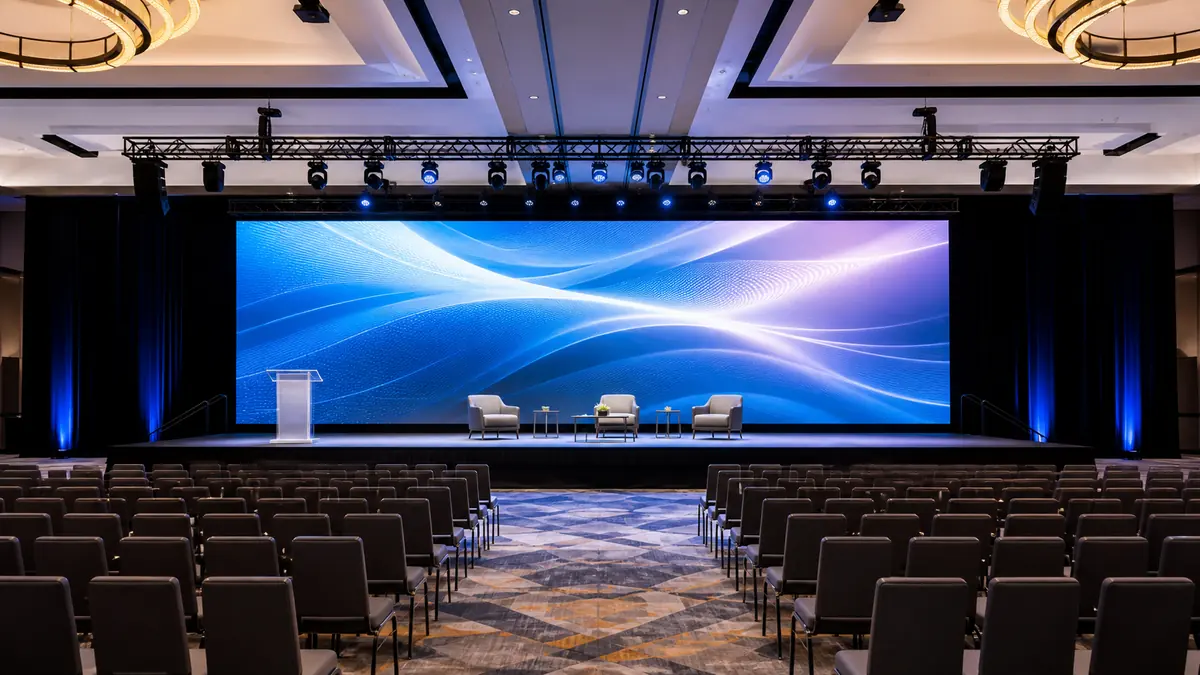
| Stage, conference, hotel ballroom, rental event | P1.9–P3.9 | Detail plus fast setup and repeated use |
| Outdoor advertising, public information, sports venue | P4–P10+ | Brightness, weather protection, and distance |
These are planning ranges, not a substitute for a site survey. Visual LED’s Leitfaden zum LED-Pixelabstand is a useful internal reference when you are narrowing the specification.
2. Indoor versus outdoor construction
An indoor wall prioritizes controlled brightness, fine pitch, quiet operation, low weight, and comfortable viewing. An outdoor wall must handle sunlight, rain, dust, temperature changes, wind loads, and a more demanding maintenance environment. That typically means higher brightness, weather protection, stronger cabinets, and more robust installation.
For example, Visual LED’s LED-Bildschirm rund um das Stadion is specified for outdoor sports applications with P5–P10 options, 5,500–8,000 cd/m² brightness, IP65 protection, and a 3,840 Hz refresh rate. Those requirements are not comparable with a low-brightness indoor lobby wall, even if the two screens cover the same area.
Do not reduce outdoor cost by using an indoor product. The saving disappears when the display is dim in daylight, vulnerable to moisture, or difficult to service.
3. Cabinet design and maintenance access
Cabinet size affects resolution, transportation, installation time, and the number of seams in the final wall. Maintenance access also matters. Front-service cabinets can be valuable when the wall is installed directly against a finished wall or inside a retail environment. Back-service designs may be more practical for permanent outdoor structures with rear access.
Rental and touring projects add another requirement: the cabinet must be lightweight, quick to lock, repeatable to align, and resilient during transport. Visual LED’s indoor rental LED display range covers P1.25–P3.91 options and 500 × 500 mm or 500 × 1,000 mm cabinet formats for stages, exhibitions, conferences, and temporary installations. Its outdoor rental range adds outdoor brightness and IP65 protection.
4. LED package, image quality, and refresh rate
The component choice influences brightness, color consistency, contrast, viewing angle, reliability, and camera performance. A high refresh rate is particularly important for events, broadcast, sports, and any environment where cameras record the wall.
Visual LED lists 3,840 Hz refresh rates across many indoor and rental products, while its outdoor front-service series lists up to 7,680 Hz. These figures are product-family specifications—not a guarantee that every configuration will look identical on camera. Ask for a camera test when filming is part of the project.
For very close viewing, COB can be worth evaluating. Visual LED’s COB fine-pitch indoor LED screens are aimed at control rooms, conference spaces, studios, and other applications that benefit from a protected surface and ultra-fine pitch options.
5. Processor and signal architecture
The LED cabinets do not decide what source is shown; the control system does. A quote may include only a basic sending card, or it may include a processor with scaling, multiple inputs, switching, redundancy, monitoring, and integration with cameras or presentation systems.
Ask these questions before comparing processors:
- How many inputs and output ports are included?
- What are the maximum input and output resolutions?
- Is redundancy required for live events or public-facing operations?
- Will the system handle camera feeds without visible scan lines or flicker?
- Is content controlled locally, remotely, or through a media server?
- Who configures the processor and trains the operator?
The cheapest processor is rarely the right place to cut cost on a wall used for live production, government communications, sports broadcasting, or high-value brand events.
6. Mounting, electrical work, and installation complexity
A wall-mounted indoor display on a prepared structure is usually simpler than a curved retail feature, a flown stage wall, a mobile truck, a stadium perimeter, or a pole-mounted outdoor billboard.
Installation cost may include:
- Steel frame or aluminum mounting system
- Structural reinforcement and engineering review
- Power distribution and electrical work
- Data cabling and signal paths
- Rigging, lifts, scaffolding, or access equipment
- On-site assembly and module alignment
- Calibration, testing, and operator training
This is why a panel-only quote and a turnkey quote should never be compared as if they are equivalent. Ask suppliers to separate hardware, control, structure, logistics, installation, commissioning, and support.
How much should different buyers budget for?
The most useful budget category is the application—not the industry label. A hotel may need a permanent lobby wall, a touring stage wall, or an outdoor event screen, and each belongs to a different cost model.
Advertising and media companies
Prioritize uptime, serviceability, brightness consistency, remote monitoring, and spare-part strategy. If the display generates advertising revenue, downtime has a direct commercial cost. Ask for a maintenance plan and replacement-module pricing, not only an attractive initial number.
Events, exhibitions, and live entertainment
Prioritize transport, setup time, quick-lock cabinets, corner protection, refresh rate, and the ability to reconfigure the wall. Rental LED is priced for repeated deployment; a lighter cabinet may justify a higher initial cost if it reduces crew time and transport complexity.
Retail and commercial brands
Prioritize viewing distance, content detail, brightness appropriate to the store, surface uniformity, low noise, and architectural integration. For glass-fronted stores, a transparent indoor LED screen may preserve visibility through a window while adding digital content. That is a different value proposition from a solid wall and should be evaluated by the commercial objective, not by panel price alone.
Government, public institutions, education, and corporate training
Prioritize lifecycle clarity, service access, operator training, documented warranty, predictable spare parts, and accessibility of the control system. A slightly higher initial specification can be more economical if it reduces service interruptions across a long procurement cycle.
Stadiums and sports venues
Prioritize outdoor readability, viewing angle, impact protection, weather resistance, camera performance, and content switching. Visual LED’s Fallstudien include an Algiers stadium P10 outdoor screen described as a 320 m² display with IP65 protection, 7,500 nits brightness, and 3,840 Hz refresh rate. Use project references as evidence of deployment experience, while confirming that the proposed specification matches your venue.
How to compare two LED video wall quotes
Use the following checklist to normalize the scope:
| Quote item | What to confirm |
|---|---|
| Screen area | Exact width, height, aspect ratio, and cabinet count |
| Pixelabstand | Exact pitch and tolerance; do not accept “HD” as a specification |
| Helligkeit | Minimum/typical brightness and whether it is calibrated |
| Bildwiederholfrequenz | Rated figure and camera test conditions |
| Schrank | Dimensions, weight, service direction, protection rating |
| Control | Processor model, inputs, outputs, redundancy, software |
| Structure | Included drawings, frame, rigging, reinforcement, and finish |
| Power | Maximum and average consumption, distribution equipment, connectors |
| Spares | Modules, power supplies, receiving cards, and replacement terms |
| Delivery | Incoterm, packaging, freight, duties, site delivery, lead time |
| Inbetriebnahme | Assembly, calibration, testing, training, and handover documents |
| Garantie | Duration, covered parts, response time, and exclusions |
If a supplier will not itemize the scope, you do not have a reliable price comparison yet.
The manufacturer perspective: where value is actually created
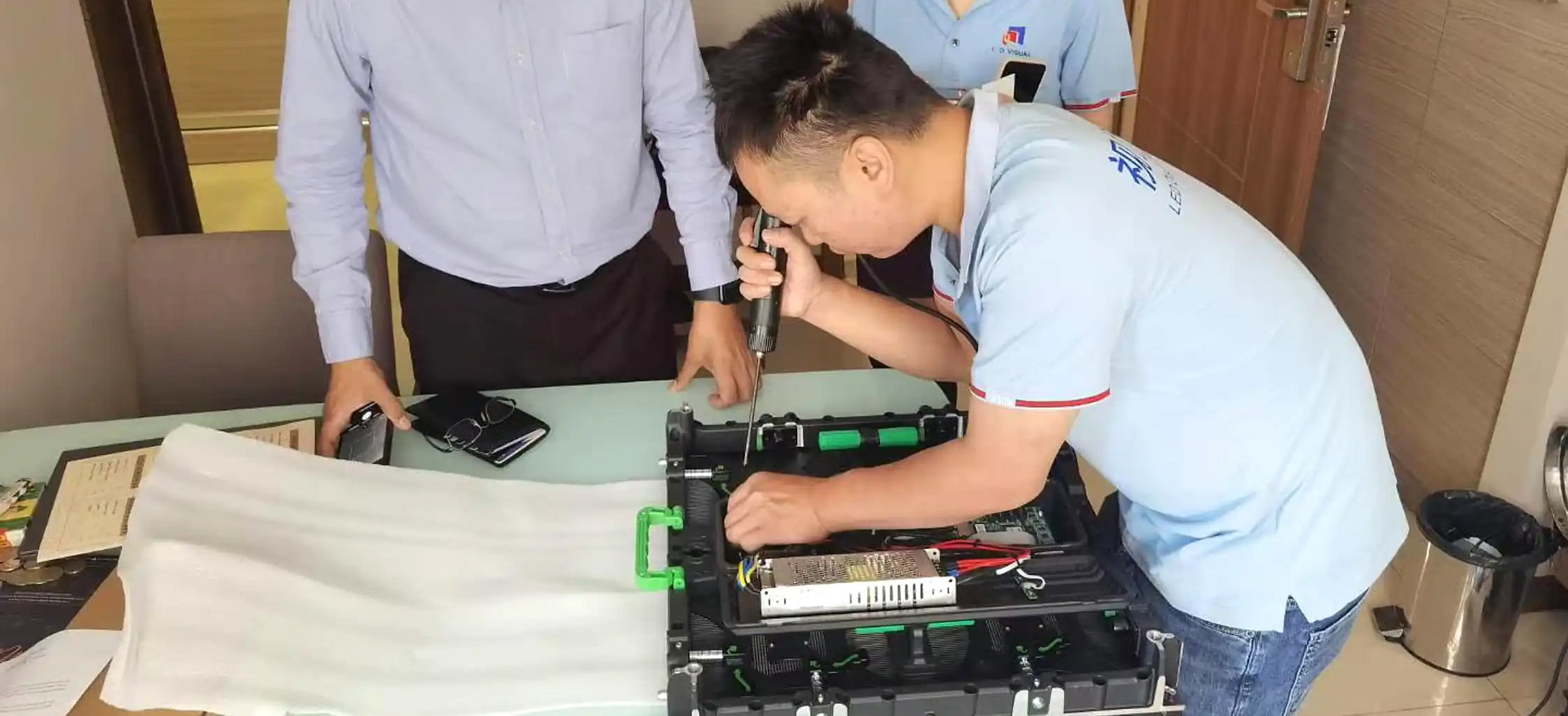
As a display manufacturer, we see the price discussion become more productive when it starts with the use case and ends with the bill of materials. Manufacturing capability matters because it affects consistency between batches, replacement-part availability, customization, quality control, and how quickly a supplier can respond when a project changes.
Visual LED describes its operation as a Shenzhen-based factory with indoor, outdoor, rental, fixed, transparent, fine-pitch, stadium, and specialty display categories. Its About Us page describes the company’s manufacturing and engineering background, while the home page highlights raw-material traceability and dedicated inspection stations. For a buyer, the practical question is not whether a supplier uses the word “factory”; it is whether the supplier can show:
- Product drawings and a controlled technical specification
- Consistent module and cabinet production
- Quality inspection records or test procedures
- Spare-part and replacement planning
- Clear technical ownership after shipment
- Relevant case studies for the intended environment
One factory can also simplify customization. A standard indoor wall, a flexible curved display, an outdoor front-service billboard, and a rental cabinet are not interchangeable products, but a supplier with a broad in-house range can help you choose between them without rebuilding the entire vendor relationship.
A practical 2026 purchasing workflow
Step 1: Define the viewing conditions
Record the closest viewer, typical viewing distance, ambient light, indoor or outdoor location, camera use, and operating hours.
Step 2: Choose the display family
Select fixed indoor, fine-pitch COB, flexible, transparent, indoor rental, outdoor rental, outdoor fixed, or stadium perimeter based on the environment and operating model.
Step 3: Freeze the physical scope
Confirm screen dimensions, aspect ratio, mounting surface, service access, power location, signal path, and delivery route before asking for a final price.
Step 4: Request an itemized quotation
Require the supplier to state what is included and excluded. Ask for hardware, processor, structure, installation, shipping, spares, warranty, and commissioning as separate lines.
Step 5: Test the system, not only the panel
For live production, request camera footage. For retail, inspect skin tones, gradients, low-brightness uniformity, and viewing angles. For outdoor projects, evaluate readability in the actual light conditions.
Step 6: Compare lifecycle support
Review spare parts, remote support, training, warranty response, software ownership, and expected maintenance access. The lowest purchase price is not necessarily the lowest cost of ownership.
Frequently asked questions
What is the average LED video wall price in 2026?
There is no dependable single average. Public 2026 supplier guides show complete indoor packages ranging from roughly $9,500 to more than $200,000, with installed per-square-foot examples varying by pitch and environment. Use those figures only as an initial benchmark; a final quote requires size, viewing distance, environment, control scope, and installation details.
Is LED video wall pricing based on square feet or square meters?
Both are used. Manufacturers commonly quote by square meter, while North American integrators often discuss installed cost per square foot. Convert units carefully and confirm whether the quoted unit price covers panels only or a complete installed system.
Is a smaller pixel pitch always better?
No. Smaller pitch is better only when the viewing distance and content detail justify it. A fine-pitch wall viewed from far away can add cost without a visible improvement. Right-size the pitch to the closest important viewer.
How much does installation add?
It depends on the venue. Wall mounting on an existing structure is different from rigging, a curved architectural installation, outdoor structural work, or stadium perimeter mounting. Request installation, electrical, structural, and commissioning costs as separate line items.
Should I buy a fixed or rental LED wall?
Choose fixed LED for a permanent location and rental LED for repeated transport or reconfiguration. Rental cabinets usually prioritize low weight, fast locking, protection, and setup speed. Fixed cabinets can prioritize long-term mounting, service access, thermal management, and the building structure.
How can I get an accurate LED video wall quotation?
Send the supplier the screen dimensions, closest viewing distance, indoor or outdoor location, brightness requirement, camera use, service direction, delivery country, installation method, and target timeline. Visual LED’s Kontaktseite can be used to start a project-specific discussion.
Final recommendation: buy the specification, not the headline price
The best LED video wall price is not the lowest number in a spreadsheet. It is the lowest complete cost for a screen that delivers the required image quality, brightness, reliability, service access, and operating life in its actual environment.
Before approving a 2026 project, make sure you can answer five questions:
- What is the closest important viewing distance?
- Is the wall indoor, outdoor, rental, flexible, transparent, or stadium-specific?
- What control, camera, content, and redundancy requirements are included?
- Are structure, electrical work, shipping, commissioning, spare parts, and warranty itemized?
- Can the manufacturer prove relevant engineering, production, quality-control, and support capability?
If you are planning a commercial, event, retail, government, education, hotel, or sports display, send Visual LED your approximate size, viewing distance, environment, and delivery country. The engineering team can then recommend a suitable product family and prepare a quotation around the real project scope.