
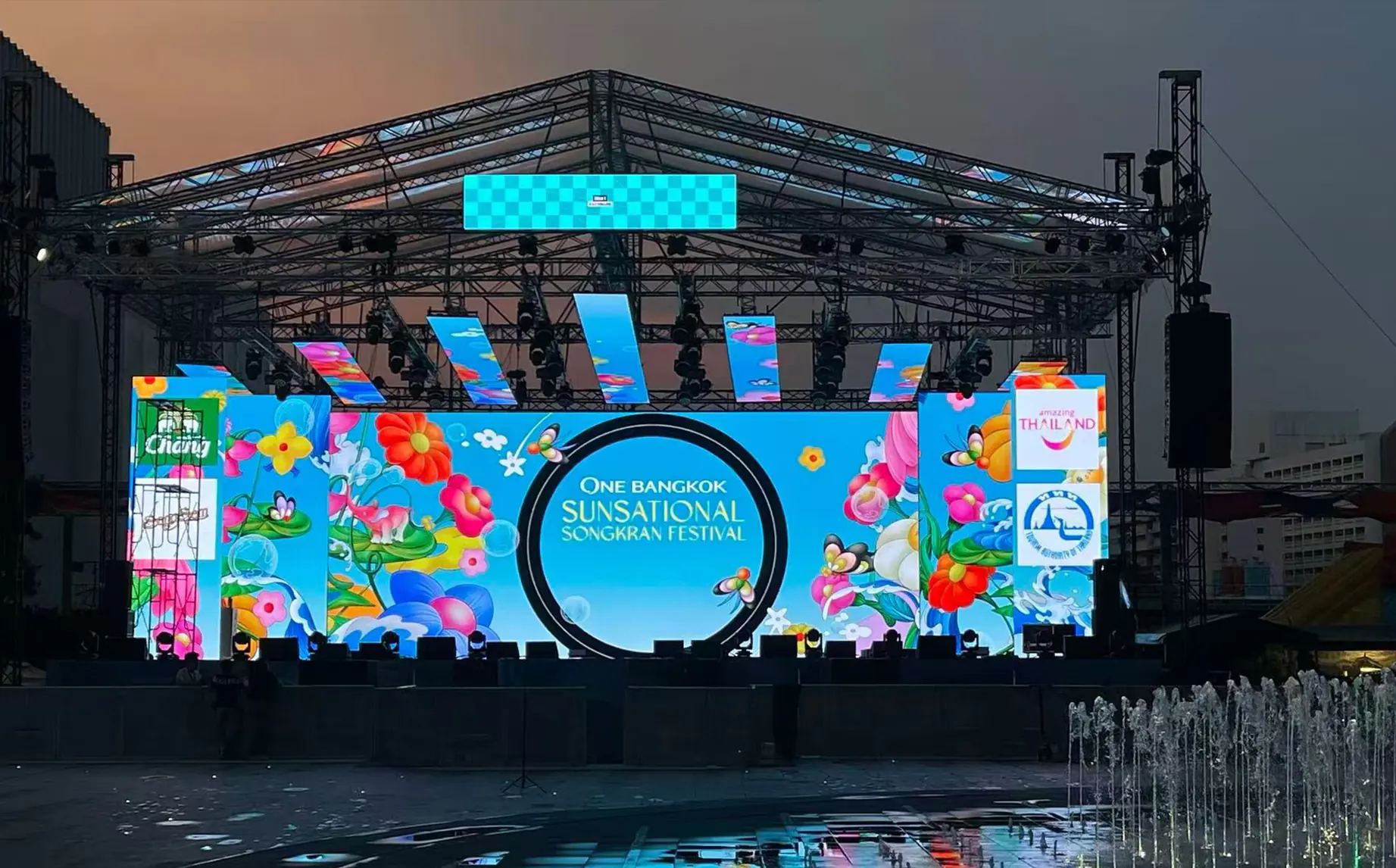
When engineering teams evaluate visual display solutions for international summits, heavy-metal touring concerts, or flagship commercial retail exhibitions, they tend to be held hostage by one relentlessly over-marketed specification: pixel pitch. The hunt for a smaller pixel pitch has become a kind of muscle memory in procurement and rental evaluation. Yet real-world failure data from the most demanding live environments consistently tells a different story — what makes or breaks an event is almost never the resolution number on the spec sheet. It lurks instead in the physical structure, rigging mechanics, control ecosystem, and power distribution architecture hiding beneath the pixel grid.
For advertising agencies, sports venue operators, and government institutions that run high-frequency, multi-venue productions, a rental LED display is not simply a glowing digital canvas — it is a high-intensity mobile infrastructure asset. Obsessing over theoretical resolution while ignoring mechanical durability, assembly cycle efficiency, and system stability under extreme environmental conditions will inevitably lead to exponential labor cost overruns and catastrophic on-site failures. Breaking free from "pitch worship" and re-evaluating rental screens through the triple lens of structural engineering, optical logic, and commercial ROI is the only path to a sound visual production investment strategy.
1. Optical Science and Visual Matching: Visual Engineering Beyond Resolution
Pixel pitch defines the physical density of light-emitting diodes, but in any real three-dimensional space, the human eye's perception of a digital image is a complex cognitive function jointly shaped by physical distance, ambient light intrusion, and screen contrast. Blindly deploying fine-pitch panels designed for broadcast studios onto large, open-air venues is the most common form of budget waste in the industry.
Pixel Fusion Threshold and Viewing Distance Calculation
Visual optics dictate that once an audience member is beyond the minimum viewing distance, the human retina can no longer resolve individual LED pixel points — the emitting dots fuse into a continuous, smooth image across the visual field. This optical fusion phenomenon means that every dollar spent on "resolution premium" beyond the critical distance is simply wasted.
The industry's standard optical evaluation model provides a precise calculation framework. At its core, it converts physical pitch in millimeters into spatial distance in meters. The rule of thumb for minimum viewing distance is the pixel pitch (mm) × 1,000, while the optimal visual comfort zone falls between pixel pitch × 2,000 and × 3,000, extending to a maximum visible limit of × 30,000. This means that for a music festival audience seated 15 meters from the screen, a P3.9 and a P2.6 panel deliver identical retinal resolution — yet the P3.9 carries decisive commercial advantages in procurement cost, protection rating, and luminous efficiency.
When specifying digital display upgrades for venues across different sectors, you must rigorously apply this distance-based optical matrix. The table below details the optical critical values for the industry's most prevalent pixel pitches, providing clear engineering boundaries for everything from high-end retail boutique windows to large-scale sports arenas.
| مسافة البكسل | Minimum Viewing Distance (Critical Point) | Optimal Viewing Zone (Comfort Zone) | Maximum Visible Distance | Core Application Scenarios |
|---|---|---|---|---|
| P1.25 mm | 1.25 m (4.1 ft) | 2.5 – 3.75 m | 38 m | High-end corporate control rooms, medical imaging displays, VIP suites |
| P1.86 – P2.0 mm | 1.86 – 2.0 m | 3.7 – 6.0 m | 56 – 60 m | Small commercial retail windows, government briefing halls, precision corporate training rooms |
| P2.5 – P2.9 mm | 2.5 – 2.9 m | 5.0 – 8.7 m | 75 m | Hotel ballroom mid-size conferences, standard exhibition booths (3–6 m viewing distance) |
| P3.91 mm | 3.91 m (13 ft) | 7.8 – 11.7 m | 117 m | Large indoor stage productions, mid-size outdoor LED displays, shopping mall atrium hung screens |
| P6.0 – P8.0 mm | 6.0 – 8.0 m | 12.0 – 24.0 m | 180 – 240 m | Large music festival main stage backdrops, stadium perimeter ribbon boards |
| P10.0 mm and above | 10.0 m | 20.0 – 30.0 m | 300 m | Stadium main scoreboards, ultra-long-distance highway or building façade advertising |
Pro tip: Before locking in any pixel pitch, request a site plan from the venue and mark out your farthest audience member. Let the distance dictate the pitch — not the other way around. Explore Visual LED's rental panel lineup to find the right pitch for your project.
AVIXA ISCR Standard and Ambient Light Contrast
When evaluating an indoor digital display, contrast and brightness dynamics are just as decisive as pixel density. Chasing raw brightness — such as deploying panels above 1,200 nits indoors — not only causes severe visual fatigue but also accelerates audience disengagement. The Audiovisual and Integrated Experience Association (AVIXA) defines precise optical thresholds for different levels of visual task through its Image System Contrast Ratio (ISCR) standard.
For educational venues or standard corporate summits where audiences simply need to extract basic judgment information from presentation slides, the environment is classified as "Basic Decision Making." The system must maintain a true contrast ratio of at least 15:1 under given ambient light conditions. However, when the scene shifts to applications demanding extreme concentration — such as architectural engineering drawing reviews, forensic evidence analysis, or premium art exhibitions — the visual task escalates to "Analytical Decision Making." At this tier, audiences must be able to discern the finest lines and dark-area details in the image, mandating system contrast of 50:1 or higher.
Achieving these stringent standards requires hardware equipped with low-grayscale-loss تعديل عرض النبضة (PWM) driver chips, supported by black-surface LED die encapsulation technology (black diodes). This ensures the screen maintains deep, rich blacks without washing gray under strong interference from stage key lights and color fill lights. Furthermore, a refresh rate of 3,840 Hz or higher is the prerequisite for eliminating moiré patterns and scan lines captured by cameras — an absolute, non-negotiable optical baseline for any advertising or PR event that relies on live broadcast and post-event multimedia distribution.
2. Spatial Geometry: Screen Size Matching and Cabinet Form Diversity
The geometric dimensions of a physical space define the framework for screen configuration. Stacking area without calculation, or forcing a standard 16:9 aspect ratio onto a space that doesn't call for it, will damage sight-line depth and audience visual experience. Truly professional design works backwards from the farthest audience member's sightline to derive the physical dimensions of the display system.
Viewing Distance Ratio Rule and Audience Capacity Model
To ensure the very last row of the audience can still clearly read text and motion graphics on screen, engineering planning must incorporate strict viewing-distance scaling formulas. A widely validated industry principle holds that the screen's vertical height should equal the maximum viewing distance divided by a constant between 6 and 8. For example, if the farthest audience member at a cultural tourism theatrical production is 24 meters from the stage, the main screen's minimum height must be set at 3 to 4 meters to deliver a comfortable visual embrace. Additionally, when designing corporate data presentations, text height must adhere to the hard rule of at least 1 inch of text height for every 4 feet of viewing distance — otherwise any complex data chart will dissolve into a blurry wash of color.
Screen width correlates strongly with event audience capacity. As the scale of the audience grows, so does the horizontal spread of the viewing angle. Accurately matching headcount to physical dimensions at the design stage effectively eliminates visual dead zones and eliminates resource redundancy.
| Target Audience Size | Core Application Scenarios & Venue Types | Recommended Screen Dimensions (W × H) | Engineering Deployment Notes |
|---|---|---|---|
| 50 – 100 | Hotel small banquet halls, corporate executive boardrooms, precision training rooms | 2.5 m × 1.5 m (approx. 8′ × 5′) | Use P1.5 to P2.5 fine pitch; strictly control brightness to avoid front-row glare |
| 100 – 500 | Government mid-size press centers, commercial real estate showcases, theater atriums | 4.5 m × 2.5 m (approx. 15′ × 8′) | Ensure content resolution matches physical pixel array point-for-point; plan for primary and secondary screen zones |
| 500 – 1,000 | Exhibition hall main venues, corporate annual summits, large-scale immersive cultural experiences | 6.0 m × 4.0 m (approx. 20′ × 13′) | Introduce video processor loop redundancy; engage a professional rigging team for aerial hang assessment |
| 1,000+ | Outdoor ten-thousand-person music festivals, stadium core zones, major public gatherings | 10.0 m × 6.0 m or mega-matrix tiling | Must deploy panels rated above 5,000 nits; apply rigorous outdoor wind-load certification |
Need a fast sizing estimate for your next event? Contact our Visual LED team for a customized configuration recommendation.
Breaking Beyond Flat Planes: The Evolution of Rental Cabinet Forms
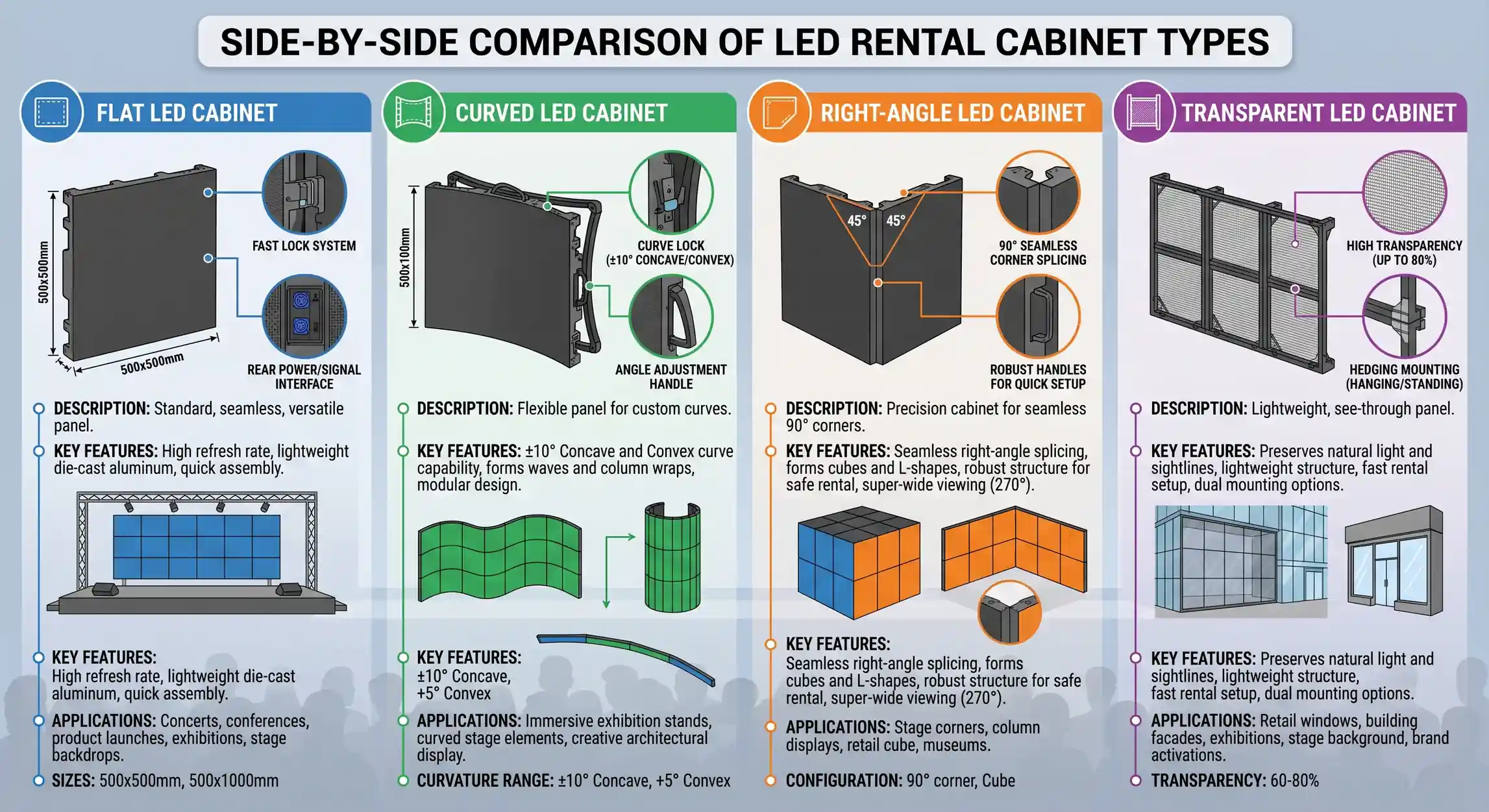
Traditional flat-panel matrices can no longer satisfy the creative demands of contemporary stage design and exhibition display. To accommodate complex architectural contours and stage concepts, rental cabinet mechanical structures have evolved into a highly differentiated product matrix. Understanding the structural advantages of these specialized forms is key to expanding a project's creative headroom.
The structural backbone of most LED video walls relies on standard flat-panel cabinets, whose magnesium-aluminum alloy rigid frame delivers the strongest resistance to deformation and the fastest bidirectional front/rear maintenance access. However, when a retail brand needs to wrap a load-bearing column, or a live entertainment company wants to create a wave-form digital sky canopy, curved cabinets أو flexible cabinets must be introduced. Curved cabinets incorporate precision arc-lock mechanisms that physically set specific deflection angles, enabling seamless concave or convex visual spaces that simultaneously expand the horizontal viewing angle (up to 160°) and dramatically enhance the sense of visual immersion.
In more aggressive exhibition booth or hotel space configurations, right-angle cabinets — capable of three-dimensional corner coverage up to 270° and often featuring an ultra-slim 65 mm profile — have become the core building block for naked-eye 3D corner visual systems. For applications requiring glass curtain wall integration or high-end auto show backlighting, transparent rental cabinets use open-circuit PCB designs that maintain brightness up to 3,800–4,000 nits while delivering extremely high light transmittance, enabling seamless layering of physical space and digital imagery.
Explore Visual LED's full cabinet ecosystem for indoor rental applications و outdoor rental applications.
3. Mechanical Engineering & Structural Considerations: The Hidden Labor Cost
Behind the display panel lies a physical mechanics system that determines both profitability and safety. Confusing fixed-installation screens with mobile rental screens is the most expensive mistake many inexperienced contractors make.
The Weight Revolution and Time Sink of Die-Cast Technology
Fixed-installation LED screens are defined as permanent infrastructure assets. Their design logic is based on a 100,000-hour service life, typically using heavy steel frames to resist long-term environmental stress. Rental screens, by contrast, are high-intensity mobile tactical equipment, designed to withstand hundreds of load/unload cycles, air transport, and complete reconfigurations. The weight differential between the two — typically more than 50% — directly determines on-site labor expenditure.
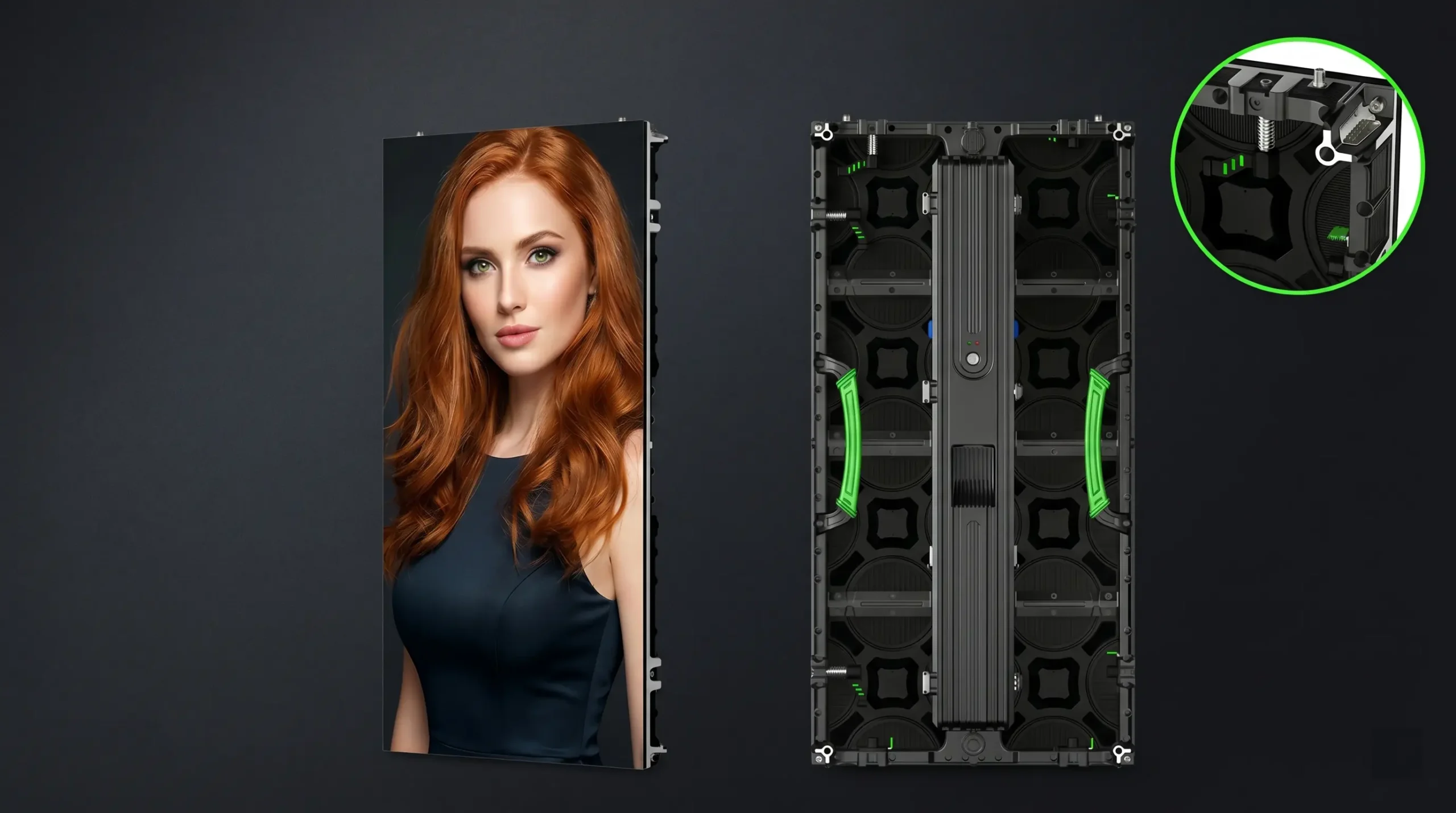
In venues with extremely tight time windows, assembling a large screen consisting of hundreds of cabinets can demand 4 to 8 grueling labor-hours. Modern top-tier rental screens use precision die-cast aluminum or magnesium alloy to hold standard 500×500 mm cabinets to a disciplined 6 to 8 kilograms. More importantly, these cabinets abandon time-consuming bolt splicing entirely, introducing tool-free self-locking mechanisms و magnetic-assisted alignment systems. When inferior cabinets with loose tolerances are used, technicians are forced to spend hours at height micro-adjusting each module's flatness to eliminate visible seams — this kind of time sink completely destroys a project's budget model.
| Engineering Evaluation Dimension | Architectural Fixed-Installation Display | Stage/Event-Grade Rental Display |
|---|---|---|
| Frame Material | Heavy channel steel, custom angle iron, thick-wall aluminum extrusions | Aerospace-grade magnesium alloy, high-precision die-cast aluminum |
| Panel Connection Logic | Heavy industrial bolt fastening, requires large mechanical aids | Tool-free quick-release latches, magnetic alignment pins, single-person closure |
| System Self-Weight | 30 – 45 kg per m² | 12 – 20 kg per m² (including frame system) |
| Damage Protection Design | Basic outer packaging only, no impact redundancy | Bottom/corner impact bumpers, module-embedded protection, professional damping flight cases |
| Power & Signal Connectors | Screw-terminal blocks, semi-permanent cable conduit routing | Aerospace-grade foolproof plug-and-pull connectors (Neutrik, etc.), self-locking in seconds |
Supply Chain Damage Resistance
Throughout the equipment lifecycle, the most serious physical damage to rental screens almost never occurs during powered operation — it accumulates during repeated rough handling, long-haul vibration, and stacked compression during transit. High-quality rental equipment must treat the protection system as an extension of the hardware itself. Beyond the convex anti-collision buffer corners surrounding each cabinet, the inner module back shell also needs the flexibility to absorb impact forces. The engineering value of a cabinet that survives countless impacts without a single dropped diode, paired with purpose-built flight cases lined with high-density damping foam, far exceeds any marginal panel specification improvement.
Suspension Mechanics and Rigging Safety
Large screens suspended above dense audiences represent a structural safety requirement where zero compromise is acceptable. Unscientific, calculation-free rigging is the root cause of stage collapses and fatal accidents. In this domain, the industry must be absolutely governed by international safety standards from organizations such as PLASA (Professional Lighting and Audio Association) و ESTA (Entertainment Services and Technology Association).
Gravity Distribution and Static/Dynamic Load Calculation
Whether using ground-supported base stacking or aerial suspension via truss systems, engineering planning must begin from fundamental load calculations. This is not simply adding up the static dead loads of the cabinets — it must also incorporate the dynamic load transfer induced by surrounding equipment operation (such as the high-speed pan movements of heavy moving-head fixtures). Every hanging chain, electric chain hoist, shackle, and lateral aluminum truss must bear a clearly marked, certification-verified Working Load Limit (WLL).
In static theatrical or corporate gala rigging scenarios, the ratio of material ultimate tensile strength to actual load — the safety factor — is strictly set at 5:1. However, when the suspension system is positioned directly over an unobstructed audience area, or involves dynamic machinery that raises and lowers repeatedly, this safety factor must be mandatorily elevated to 6:1 or even 8:1. Any use of non-standard hardware of unknown provenance, or estimating the center of gravity based purely on "experience," violates the foundational principles of professional engineering.
Wind Load and Environmental Force Challenges
Large screens deployed outdoors, beyond requiring protection against rain (minimum IP65 sealing requirement), also face intensely violent aerodynamic challenges. A massive, high-brightness LED screen in an open area behaves like a giant sail. When wind speed exceeds a certain threshold, the wind pressure force generated on its surface will instantaneously exceed the yield strength of standard aluminum structures.
Without a wind pressure verification report and counterweight (ballast) ratio calculation sheet stamped and approved by a qualified third-party structural engineer, any outdoor main screen assembly is equivalent to unpermitted construction. The system architecture must not only precisely calculate the moment balance of the support legs, but also design mesh or louvered wind-pass channels to allow airflow to permeate the structure. Production teams must also establish a real-time meteorological monitoring–triggered emergency de-rig protocol — the last line of defense for the safety of tens of thousands of people at a major public gathering.
4. Control Systems and Electrical Architecture: The Data Nervous System
Outstanding light-emitting diodes are merely the body of the digital canvas. What truly determines image vitality and system survivability is the data processing brain hidden inside the chassis and the vast, complex power supply network running beneath it all.
Signal Processing and Pixel-Perfect Native Mapping
High-specification large-scale live productions often deploy native 4K or even custom-ratio 8K source material. If the video processor cannot support these enormous data streams, or if the playback output resolution does not align with the physical pixel array of the LED screen, the system will be forced to execute destructive scaling operations. This non-native stretching and compression directly causes jagged aliasing on text edges, aspect ratio distortion of corporate logos, and a cliff-drop in overall image sharpness.
The highest tier of visual execution standards requires that the content production side achieve absolute native resolution mapping. For example, when a video wall's physical dimensions calculate out to precisely 3,456 × 1,240 pixels, the video output device must emit exactly the same pixel array without deviation. Simultaneously, accounting for potential visual occlusion from physical bezels, core graphic interfaces must be hard-inset by a 5–10% safe zone, preventing critical information from being cropped.
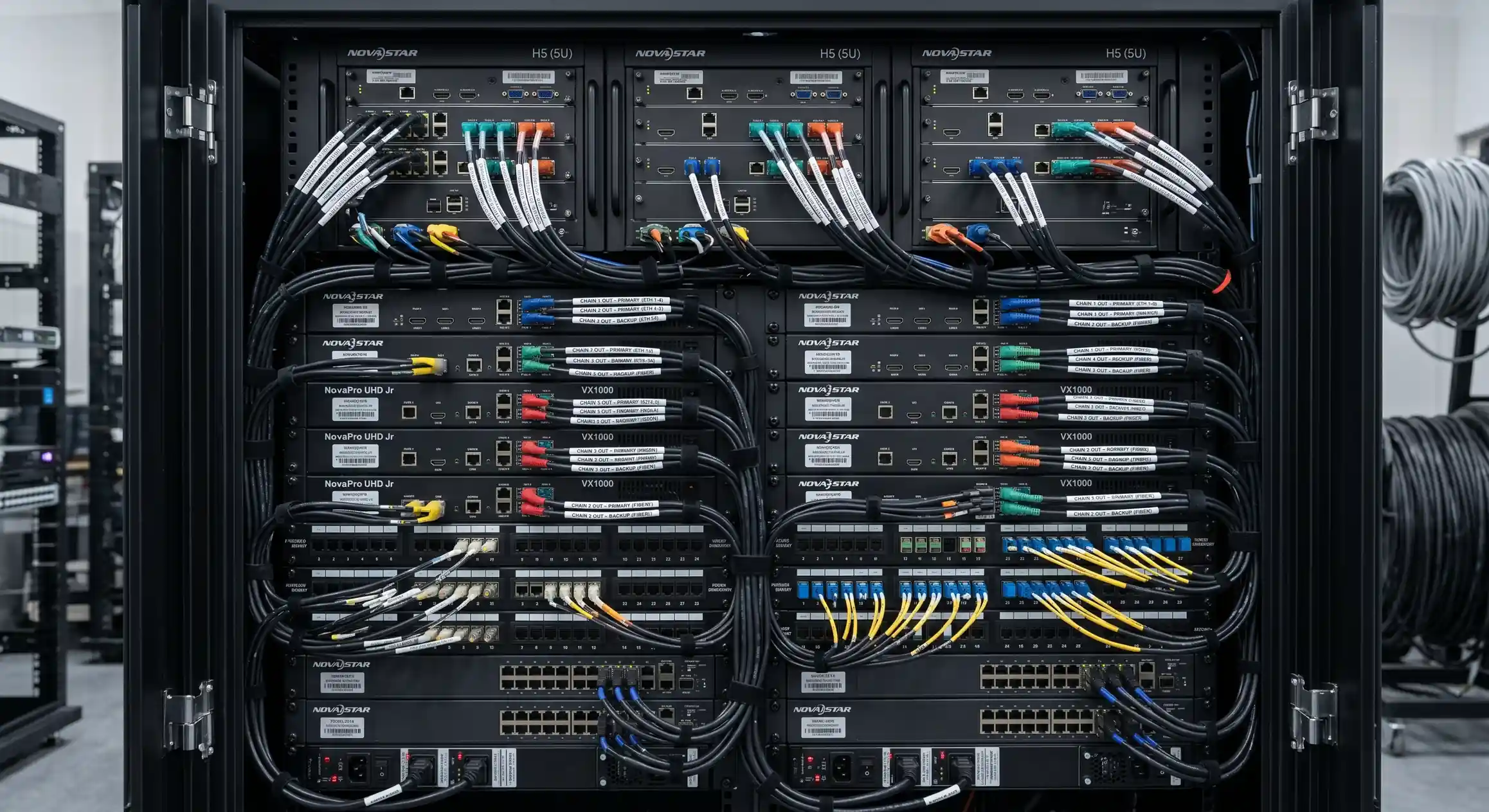
To support High Dynamic Range (HDR) and wide color gamut performance, the processor must construct a complete 10-bit data pipeline. Whether deploying Novastar, Colorlight, or Brompton high-end processing clusters, only by ensuring that every link in the chain from media server to final receiving card undergoes zero color downgrade can you perfectly reproduce the smooth gradient of a sunset sky, completely eliminating the ugly color-banding streaks that haunt lower-spec systems.
Power Thermal Dissipation and Data Redundancy Isolation
A large-scale LED video wall is an energy-devouring machine. A 20×12 ft screen may consume 15 to 30 amperes or more of sustained current, easily overwhelming a venue's standard electrical infrastructure. Power network configuration must undergo meticulous phase load balancing calculations, distributing the enormous current evenly across three-phase AC to absolutely prevent neutral wire overload meltdown and the resulting fire risk from current accumulation.
Accompanying high-power operation is an astonishing thermal output. Rental panels cannot rely on fans that readily accumulate moisture and dust. Top-tier equipment uses high thermal conductivity aluminum alloy back housings, transforming themselves into large passive heat dissipation fins, thereby extending component service life and preventing hotspot formation and color shift. In cabling protocol, high-voltage power cables (strong current) and Ethernet image transmission lines (signal current) must be strictly separated. Even minimal Electromagnetic Interference (EMI) leakage can induce unpredictable collective flickering and signal loss across tens of thousands of pixels.
To counter unpredictable cable cuts or receiving card failures, high-end systems mandate a closed signal loop redundancy architecture throughout the entire transmission topology. If the primary trunk line is severed, the backup channel will take over the signal in reverse within milliseconds — ensuring that the tens of thousands of audience members before the screen remain completely unaware of the near-catastrophic failure unfolding behind it.
5. Financial Logic: The TCO-Based Commercial Moat
All technical specifications ultimately land on cold financial statements and return-on-investment ratios. In the rental LED screen commercial model, comparing purchase prices alone is a profoundly misleading trap.
Due to the use of exceptionally expensive aerospace aluminum, high-precision locking components, individually reinforced corner guards, and standard-configured heavy-duty flight cases, genuine "rental-grade" panels typically carry price tags of $1,500 to $4,000 per square meter — far exceeding the $800 to $3,000 per square meter range of typical fixed-installation screens. On the surface, this appears to be a steep initial CAPEX. However, the core profit engine of event production and equipment rental companies is driven by a utilization rate model.
When an event company can maintain its equipment fleet's annual rental day rate above the healthy threshold of 60%, high-quality rental equipment typically achieves capital payback within 18 to 24 months, subsequently entering a pure profit generation phase. Conversely, if initial cost temptation leads to the purchase of shoddily manufactured budget screens, the wasted labor-hours from assembly difficulties, the maintenance nightmares of pulling down an entire wall to replace a single dead pixel (due to the absence of fast front/rear maintenance design), and the annual maintenance cost directly spiking to 15–20% of the purchase price will undo all the apparent savings. And that's before factoring in breach-of-contract penalties and reputation destruction from on-site production failures.
If your core business is not high-frequency AV touring rentals, or if your screen's projected annual utilization falls below 40%, self-owning this heavy capital asset will become a cash-flow black hole. In that scenario, engaging a local professional equipment service provider for per-event support — or sourcing directly from a manufacturer to access the most competitive customized LED display pricing by eliminating redundant distributor margin layers — is the strategically sound approach to defending your cash flow.
Learn more: Visual LED's transparent pricing approach gives you direct manufacturer access with no middlemen markup. Get a custom quote today.
Conclusion: Reject the Superficial — Embrace Hardcore Visual Infrastructure
The digital visual landscape is experiencing unprecedented expansion. But behind the digital euphoria of pixel pitch breaking through physical limits after physical limit, the foundation of any successful event is always built upon cold physical laws and rigorous engineering science.
From grayscale optical verification meeting AVIXA ISCR standards to the mechanical derivations that stress-test against PLASA rigging safety factors; from the anti-shock detail of die-cast cabinet construction to the power and data network isolation that guarantees millisecond-level seamless switching — these are the core elements that exist beyond the word "resolution," and they are the underlying logic that protects multi-million-dollar event budgets from instantaneous collapse.
Whether you are a sports venue courting top-tier brand sponsorships, or a cultural tourism operator building a visually overwhelming large-scale theatrical experience, decision-makers must move beyond the single-parameter trap. For event teams seeking to build a genuine professional moat in a fiercely competitive market, selecting a manufacturing system with deep R&D foundations capable of delivering end-to-end solutions is paramount.
Stop paying for flashy buzzwords. Dive deep into the industrial-grade visual infrastructure built by leading manufacturers like مؤشر LED مرئي, and ensure that the skeletal architecture behind every screen is every bit as flawless as the light and shadow it displays.
Looking for the right rental LED panel for your next event? Explore Visual LED's full product range أو contact our team for a free technical consultation and custom quote.
Further Reading
- AVIXA ISCR Standard Overview — Understanding contrast ratio requirements for professional AV systems
- PLASA Technical Standards & Rigging Safety — International rigging and structural safety specifications for live events
- ESTA Standards for the Entertainment Industry — Authoritative technical standards for entertainment infrastructure
Tags: LED rental panels, pixel pitch, rental LED display, event production, video wall, rigging safety, AVIXA ISCR, LED cabinet types, TCO, LED display ROI