
In the digital visual economy of 2026, large-format LED displays have moved from being a premium add-on to becoming core infrastructure for commercial events, public gatherings, concerts, retail environments, and institutional communication. Whether the project is a global technology launch, an outdoor music festival, an immersive retail activation, or a high-level government conference, LED screens now define how audiences see, remember, and share the experience.
For event organizers, advertising agencies, AV integrators, hotel groups, and finance teams, however, LED screen rental pricing can still feel like a black box. Quotes often combine hardware, rigging, transport, processing, technicians, power distribution, insurance, and content support into a bill that can quickly reach thousands or tens of thousands of dollars.
This buyer guide breaks down the pricing logic behind the 2026 LED screen rental market, the hidden cost traps that often appear below the headline quote, and the hardware trends reshaping the industry. Most importantly, it challenges one common assumption: renting is not always the financially optimal choice. For companies with medium or high event frequency, shifting from repeatedly paying rental fees to owning professional rental-type LED screen assets can become the stronger long-term strategy.
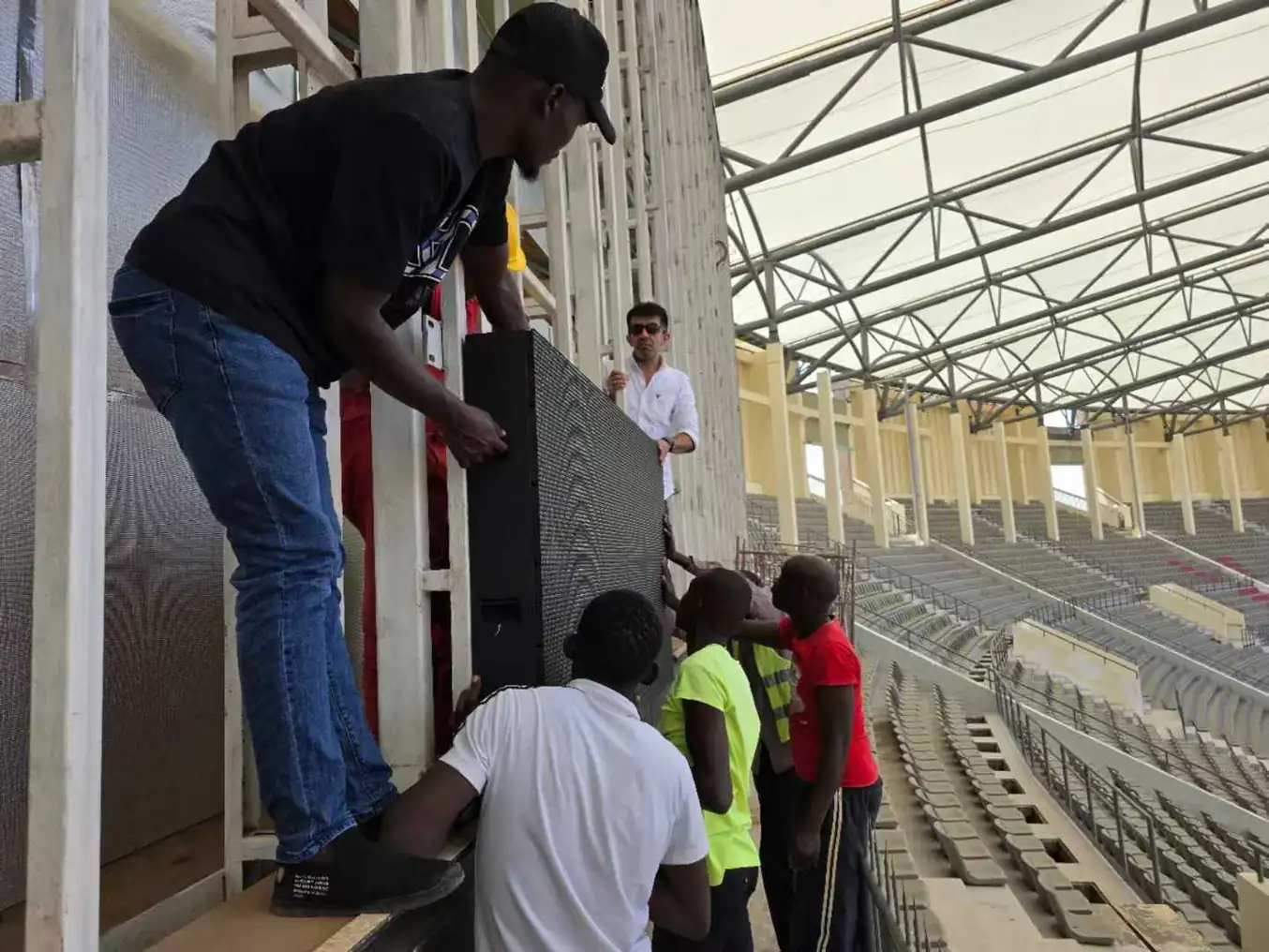
Image description: A technical crew installs modular LED display cabinets on a stage before a corporate product launch, showing how rental LED screens are built from individual panels rather than one single screen.
1. 2026 LED Screen Rental Pricing Benchmarks
Before comparing rental and ownership strategies, buyers need to understand the pricing baseline. LED screen rental rates are fairly standardized in mature markets, but the final quote is shaped by many dynamic variables. Rental companies use these variables to maximize asset utilization and margin; buyers need to understand the physical and financial logic behind them.
1.1 Two Common Pricing Models: By Area and By Panel
In North America and Western Europe, the industry benchmark for a standard one-day LED screen rental often falls around $50 to $70 per square foot. Converted into metric terms, that is roughly $540 to $750 per square meter, depending on the screen type, region, labor structure, and project requirements.
Suppliers usually calculate rental cost in two parallel ways:
Price per square foot or square meter focuses on the final visible screen size. For example, a common 16 ft x 9 ft screen used for corporate events and mid-sized productions has 144 square feet of display area. At $50 to $70 per square foot, the first-day hardware rental may fall between $7,200 and $10,080. A larger 20 ft x 12 ft screen for a festival or outdoor stage has 240 square feet of display area and may cost $12,000 to $16,800 for the first day before add-ons.
Price per panel reflects the physical rental inventory. Modern LED walls are built from standardized cabinets, often 500 mm x 500 mm or 500 mm x 1000 mm. A standard indoor modular LED cabinet may rent for about $150 to $250 per panel per day, depending on pixel pitch and product quality. A 16 ft x 10 ft screen may require around 40 standard cabinets, placing the first-day hardware cost near $8,000 at $200 per cabinet.
Both models should be checked against each other. If a quote looks unusually high, calculating the implied cost per square meter and per cabinet can quickly reveal whether the supplier is adding a premium.
1.2 The Multi-Day Discount Effect
LED rental pricing usually follows a simple rule: the first day is the most expensive, and additional days cost much less. The reason is practical. Once the screen leaves the warehouse, the supplier has already absorbed the major fixed costs: picking, testing, trucking, unloading, installation, alignment, and initial technical setup.
For many rental contracts, the second and following days are charged at roughly 20% of the first-day rate. This creates a steep drop in the average daily cost for multi-day events.
| Rental duration | Estimated total cost for a 16 ft x 9 ft indoor screen | Commercial logic |
|---|---|---|
| 1 day | $7,200-$10,080 | Includes dispatch, preparation, setup, and first-day use |
| 2 days | $8,640-$12,096 | Day two adds about 20% of the first-day rate |
| 3 days | $10,080-$14,112 | Common for trade shows, weekend festivals, and conferences |
| 7 days | Around $21,000 and up | Weekly rentals may receive 30%-40% bundled discounts |
| 1 month | $10,000-$15,000 for selected packages | Long-term site rentals use separate pricing and may have the lowest daily average |
Regional labor economics matter. The figures above reflect high-wage markets such as the United States and Western Europe. In parts of the Middle East, Southeast Asia, and other labor-cost-sensitive regions, practical daily rates may be 20%-40% lower, especially when logistics and warehousing are local.
2. Technical Variables That Reshape the Budget
LED screen rental cost is not determined by size and duration alone. The second major cost driver is the underlying display specification: pixel pitch, brightness, refresh rate, cabinet design, weather protection, processing architecture, and maintenance capability.
2.1 Pixel Pitch and Viewing Distance
Pixel pitch is the physical distance between the centers of adjacent LED pixels, measured in millimeters. A P1.9 screen has pixels spaced 1.9 mm apart; a P3.9 screen has pixels spaced 3.9 mm apart.
Smaller pixel pitch means higher pixel density. Higher pixel density requires more LEDs per square meter, more driver ICs, denser PCB design, more advanced calibration, and stronger video processing. That is why fine-pitch LED screens cost more to rent and buy.
For more background, Christie explains the viewing-distance relationship in its guide to pixel pitch in LED video walls, while Planar provides a useful technical overview of direct-view LED viewing distance.
| Pixel pitch range | Typical application | Typical rental positioning |
|---|---|---|
| P1.9-P2.0 | Premium product launches, boardrooms, broadcast studios, close camera work | Highest-cost fine-pitch category |
| P2.6-P2.9 | Corporate events, trade shows, award ceremonies, hotel ballrooms | Mainstream premium indoor rental range |
| P3.9-P5.0 | Concerts, stage backgrounds, festivals, sports, larger viewing distances | High-volume rental standard with stronger cost control |
A practical rule of thumb: do not over-specify pixel pitch beyond the audience's actual viewing distance. Renting a P1.9 screen for an audience standing 10-15 meters away is usually wasted budget. Conversely, using a coarse outdoor screen for close-up retail or broadcast work can damage perceived quality.
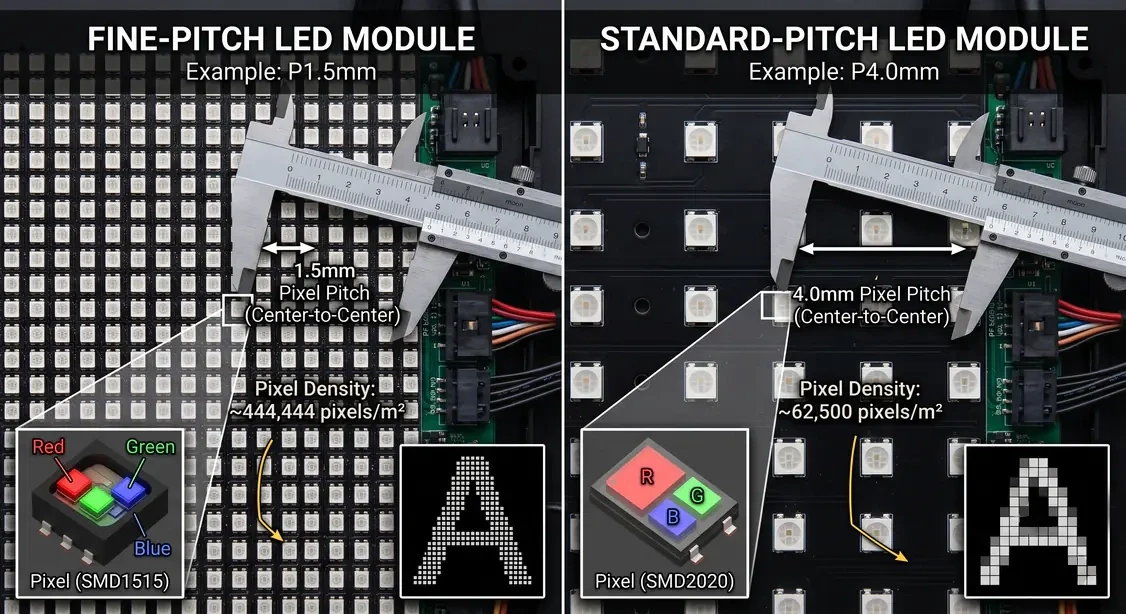
Image description: A close-up comparison of two LED modules, one with fine pixel pitch for close viewing and one with wider pixel pitch for stage or outdoor viewing.
2.2 Indoor vs Outdoor LED Screens
Outdoor LED screens usually cost 30%-50% more than indoor screens of similar size. That premium comes from engineering requirements rather than marketing.
First, outdoor screens need much higher brightness. Indoor LED screens often operate around 800-1,200 nits. Outdoor screens exposed to daylight may require 4,000-6,000 nits or more. That increases LED chip requirements, power consumption, heat management, and cabinet ventilation.
Second, outdoor displays need environmental protection. The IEC explains that Ingress Protection ratings are used to classify protection against dust and liquid intrusion. For rental LED screens, buyers commonly look for IP65-rated front protection and suitable rear protection for rain, dust, and outdoor handling.
Many professional outdoor rental screens also use protective surface technologies such as GOB (Glue on Board), which covers the LED module with a transparent protective layer. This improves resistance to moisture, impact, and LED damage during frequent transport and setup.
3. Hidden Costs Below the Headline Quote
A "screen-only" quote may represent only 60%-70% of the final project cost. The full rental bill often includes structural engineering, rigging, technicians, processing, logistics, power, insurance, cleaning, and deposits.
3.1 Installation, Ground Support, and Rigging
LED screens are heavy modular structures. Physical deployment can be simple or very complex depending on the venue.
Ground-stacked LED walls are usually the most cost-efficient. They rely on floor support, base plates, ballast, and rear bracing. Basic labor and structure charges may range from several hundred dollars to a few thousand dollars, depending on scale.
Flown LED walls are more expensive and higher risk. If the screen is suspended from truss, ceiling points, or a stage structure, the project may require certified riggers, load calculations, CAD drawings, motors, truss, and site-specific safety planning. OSHA's crane and suspended-load rules are a reminder that overhead loads are not casual design choices; buyers should review safety expectations such as OSHA's guidance on operation around suspended loads.
Curved, cylindrical, wave-shaped, or other custom LED layouts can add 20%-30% or more to installation cost because they require special locks, alignment checks, and extra engineering time.
3.2 Signal Processing and On-Site Technical Support
Once the cabinets are assembled, the screen is only physically ready. A complete event still needs signal routing, video processing, brightness control, color calibration, backup planning, and live troubleshooting.
An experienced LED technician may cost $400-$700 per day, and senior engineers for complex shows can cost more. Their role is not just setup; they monitor signal health, adjust brightness, manage backup sources, and respond instantly if a module, receiving card, or processor fails.
LED walls also need professional control systems. A typical screen cannot simply plug directly into a laptop HDMI cable and behave like a TV. It requires sending cards, receiving cards, video processors, scalers, and sometimes multi-input switchers. Processing and playback systems may add $300-$500 per day, while live camera switching and show control can push technical production into the $1,500-$4,000 per day النطاق.
Content can also become a hidden cost. If the supplier must adapt graphics, slice content across unusual screen ratios, build templates, or program interactive media, expect a separate content-management or creative-production fee.
3.3 Logistics, Power, Insurance, and Deposits
LED rental is a logistics-heavy business. Local delivery within 50 miles may cost a few hundred dollars. Regional delivery, crew travel, long-distance transport, and overnight stays can push logistics into the thousands.
Power is another common blind spot. Large outdoor LED walls can consume hundreds of kilowatt-hours in a single day. If the venue does not have enough available power, the buyer may need generators, distribution boxes, feeder cable, and electrician support. The U.S. Department of Energy's overview of LED basics is useful background for understanding why LED technology is efficient at the diode level, but event LED walls can still draw significant total power because of their size and brightness.
Insurance and deposits also matter. Suppliers may require equipment insurance, damage waivers, cleaning fees, or security deposits because LED rental inventory can represent tens or hundreds of thousands of dollars in asset value.
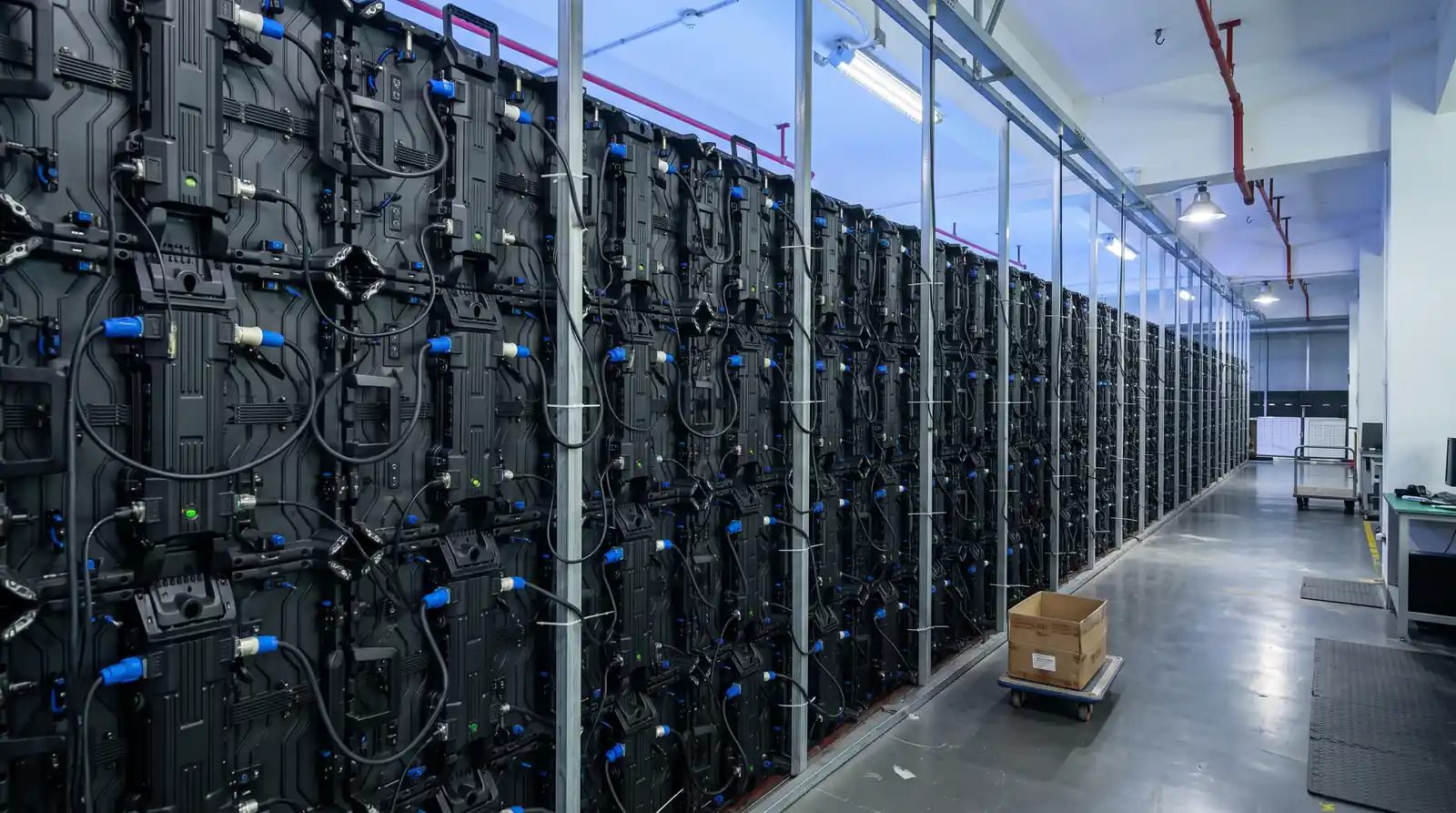
Image description: A large outdoor LED wall installed on a festival stage, with power distribution, signal cable, and structural support visible behind the display.
4. LED Screen Strategy by Industry Scenario
Different industries need different LED screen strategies. The right specification depends on viewing distance, content type, camera use, audience size, event frequency, and ROI expectations.
| Industry and scenario | Recommended screen type | Typical rental estimate | Key considerations |
|---|---|---|---|
| Advertising, PR, annual meetings, product launches | Indoor P1.9-P2.9, medium to large screen | $2,500-$5,000+ per day | Color accuracy, grayscale, camera performance, premium appearance |
| Retail, exhibitions, pop-up stores | Indoor P1.86-P2.5, small modular or custom layout | $3,000-$6,000+ per day | Close viewing, low moire risk, flexible cabinet sizing |
| Stadiums, festivals, concerts, sports | Outdoor P3.9-P5.0, large arrays | $10,000-$35,000+ per day | High brightness, IP protection, high refresh, long-distance logistics |
| Hotels, weddings, banquet halls | Indoor P2.9-P3.9, small or medium screen | $1,000-$2,500+ per day | Budget control, quiet operation, simple playback |
| Government, education, public institutions | Indoor standard screen or outdoor mobile trailer | $1,750-$5,000+ per day | Predictable budgeting, easy setup, reliability, compliance |
5. The Strategic Shift: Renting vs Owning Rental-Type LED Screens
The most important financial insight is simple: for many advertising agencies, touring organizers, exhibition contractors, hotels, and brands with frequent events, continuous external rental can become a slow financial leak.
The key comparison is not "renting a screen" versus "buying a fixed wall." The real comparison is between paying for repeated rental services and owning a professional rental-type LED display system designed for repeated assembly, transport, and redeployment.
5.1 What Makes a Rental-Type LED Screen Different?
Many buyers assume a fixed-installation LED screen and a rental LED screen are the same. They are not.
Professional rental-type LED cabinets are built for frequent setup, teardown, transport, and impact exposure. A high-quality rental cabinet usually includes:
Lightweight die-cast aluminum construction. Rental cabinets avoid heavy steel structures where possible. A common 500 mm x 500 mm cabinet may weigh around 7-10 kg, making handling faster and reducing labor cost.
Fast-lock mechanisms. Cabinets are designed to connect in seconds without complicated tools. This matters because event labor is expensive and setup windows are short.
Tool-free front or rear maintenance. In a live event, failure tolerance is close to zero. A good rental screen allows technicians to replace a module, power supply, or receiving card quickly, sometimes without dismantling the entire wall.
Flight-case logistics. Rental LED screens are stored and transported in professional flight cases with wheels and foam protection. This protects delicate semiconductor equipment during trucking, air freight, sea freight, and venue handling.
Processing and image-performance redundancy. Professional rental screens often support high refresh rates, strong grayscale performance, camera-friendly operation, and automatic brightness adjustment.
مؤشر LED مرئي clearly distinguishes this category on its rental-type LED screen page, noting that it sells rental-type displays for professional itinerant uses rather than acting as a rental supplier.
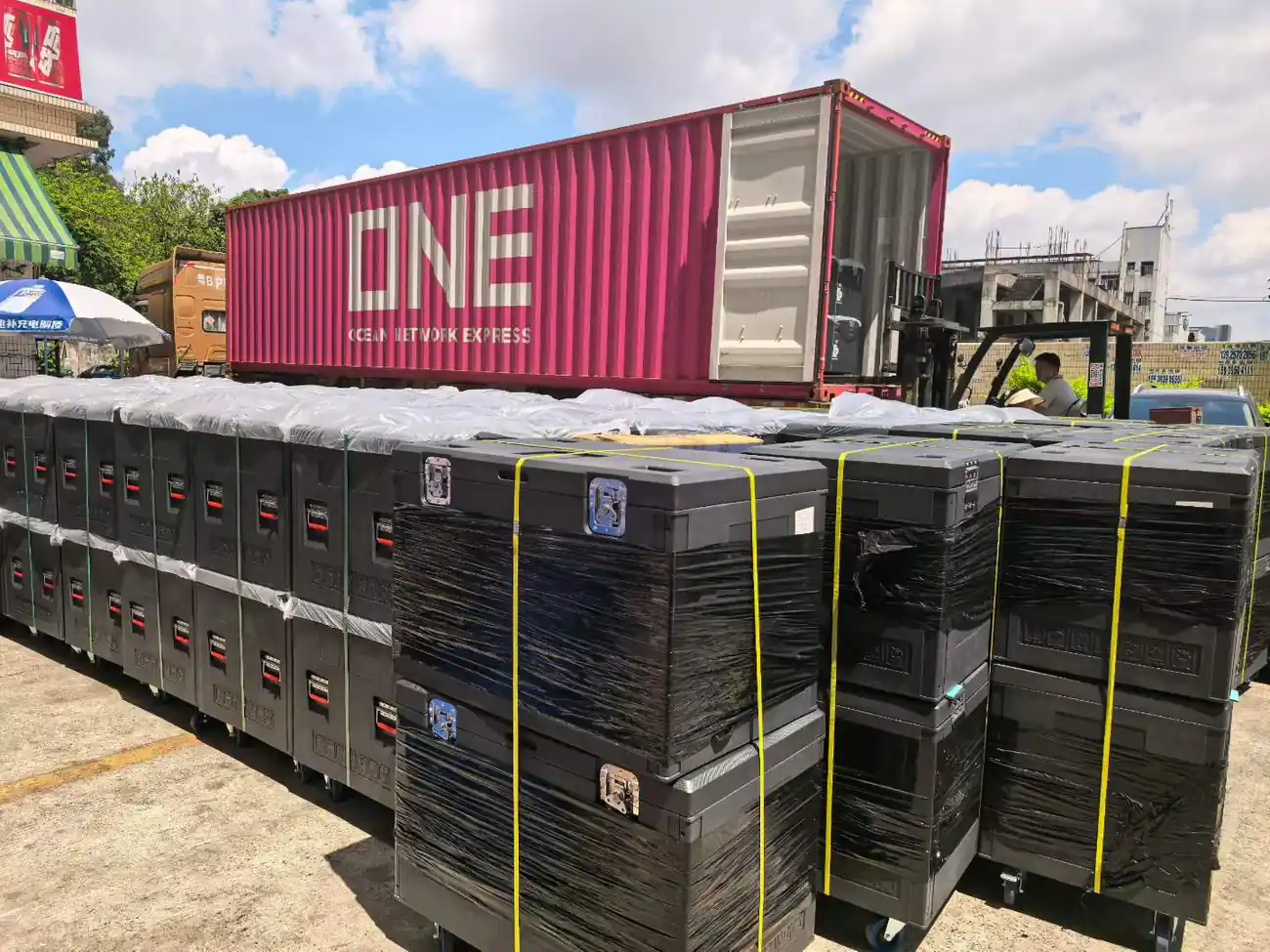
Image description: Professional rental LED display cabinets packed in wheeled flight cases, showing how rental-type LED assets are protected during repeated transport.
5.2 Breakeven Point: When Ownership Beats Rental
For a finance team, the decision should be calculated, not guessed. In many real projects, renting a large LED wall for several days can cost 20%-30% of the purchase price of a comparable rental-type LED system.
Consider a mid-sized event or exhibition company that regularly needs a 32-square-meter indoor LED screen, such as an 8 m x 4 m wall.
Path A: Continue renting.
For each two-day event, the company rents a high-quality indoor LED screen with logistics, basic installation, and one on-site technician. A conservative total project cost may fall between $8,000 and $15,000. If the company runs 10 such events per year, direct rental spending may reach $100,000-$150,000. At the end of the year, the company owns no visual asset and must pay again for every future event.
Path B: Buy a rental-type LED system.
The company purchases directly from a professional LED screen manufacturer. If a professional P3 indoor rental-type LED system costs around $900 per square meter, the 32-square-meter screen hardware costs about $28,800. Add control systems, flight cases, spare modules, cables, and accessories at roughly 12%, and the total initial asset investment may be around $32,300.
Breakeven result.
If each rental event costs $8,000-$15,000, the owned system can pay for itself after roughly three to four events. After breakeven, the screen shifts from cost center to profit center. Future project costs are mainly internal labor, storage, transport, maintenance, and depreciation.
This is the central ROI logic: if annual usage exceeds four or five meaningful events, ownership deserves serious analysis.
5.3 Strategic Control Beyond the Spreadsheet
Owning high-quality rental-type LED display solutions does more than improve financial math.
It removes schedule dependency. During peak event seasons, regional rental companies may run out of premium inventory and raise prices by 15%-35%. Owning your own screen gives the business more control over timing, client response, and quality.
It enables multi-scenario reuse. The same modular screen can support roadshows, hotel banquet events, retail windows, headquarters lobbies, exhibitions, livestream sets, and training rooms. When the asset is not traveling, it can still create value.
It reduces middleman exposure. Traditional rental companies act as asset owners, logistics coordinators, and technical intermediaries. Direct manufacturer purchasing can reduce markups and give buyers better access to technical documentation, firmware support, spare parts, and training.
6. Buyer Pitfalls and Negotiation Strategies
For companies that use LED screens only once or twice per year, rental may still be the right choice. In that case, the goal is to control risk and avoid technical traps.
6.1 Watch for Specification Games
Refresh rate. Low-cost rental screens may operate at 1920 Hz or below. That can look acceptable to the naked eye, but cameras and smartphones may capture scan lines, flicker, or moire. For events designed for livestreaming, social sharing, broadcast, or professional photography, require 3840 Hz to 7680 Hz refresh performance in the contract.
Grayscale and low-brightness performance. A good LED screen should maintain smooth grayscale and color transitions when brightness is reduced for stage lighting. Poor screens can show banding, color blocks, and crushed shadow detail.
Signal redundancy. For major events, do not save a small amount of money by removing backup architecture. Ask for redundant signal paths, backup processors, spare modules, spare receiving cards, and a clear failure-response plan.
6.2 Compress Cost Through Better Contracting
Bundle services where practical. If one supplier can provide LED screens, audio, lighting, truss, and show control, the overall project may receive a 10%-15% bundled discount and reduce coordination friction.
Lock hidden charges early. Confirm overtime rates, weekend premiums, holiday rates, cable-distance assumptions, power responsibility, bad-weather clauses, cleaning fees, delivery windows, and damage liability before signing.
Use timing as leverage. If the annual event calendar is predictable, negotiate off-season framework agreements before peak months. Early commitment can secure priority inventory and better rates.
6.3 Build Internal Capability
Whether a company rents long-term or decides to own equipment, LED display operation is becoming more accessible. Modern media players, control software, and cloud content management systems allow trained non-engineers to schedule content, run diagnostics, and update playlists from a laptop or mobile device.
With manufacturer training, videos, assembly diagrams, and cloud documentation, internal staff such as marketing coordinators, hotel AV teams, junior IT staff, or operations managers can learn basic cabinet assembly, power and signal connection, and daily playback control. This reduces dependence on expensive external technicians for every routine event.
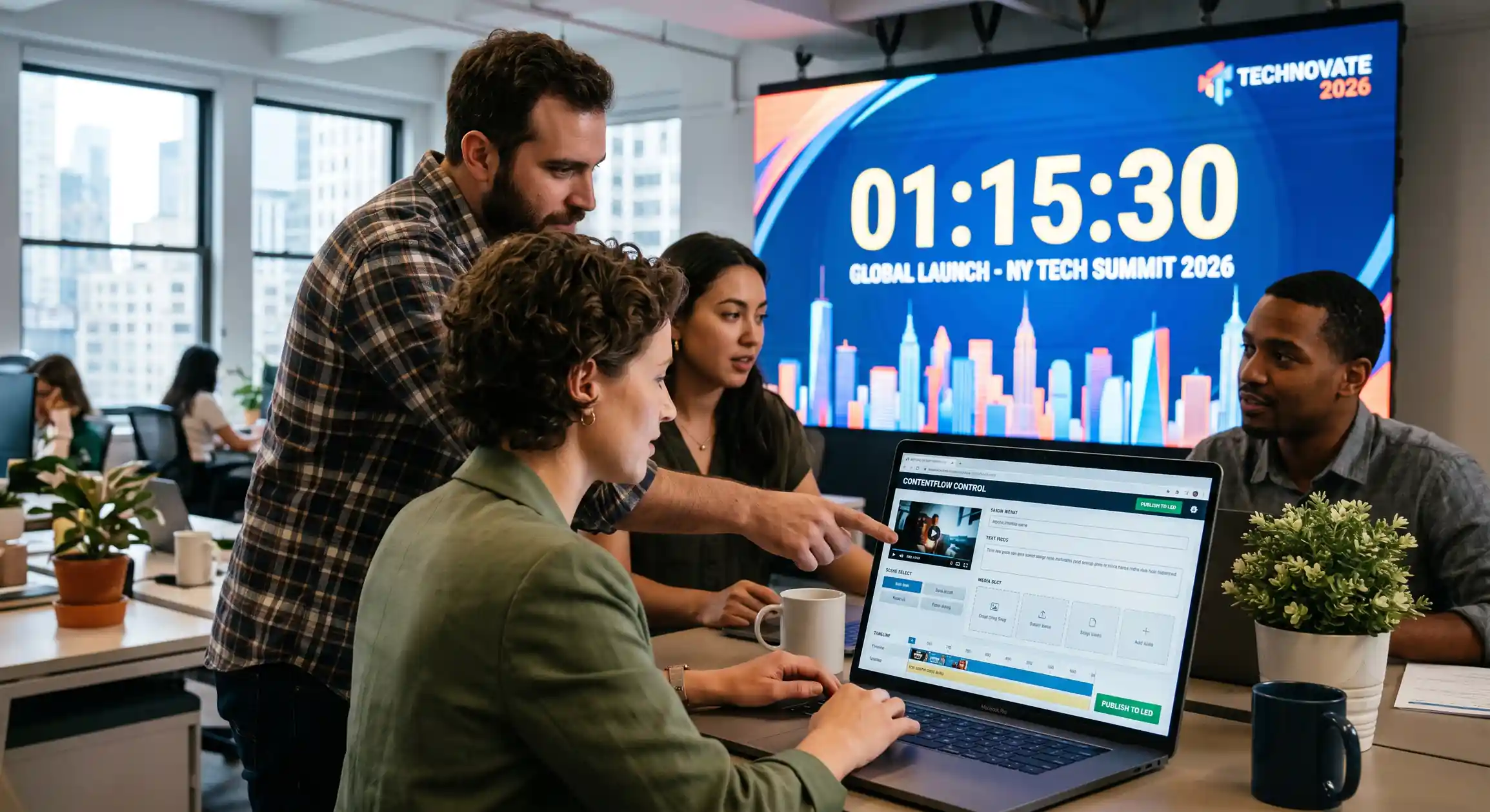
Image description: A non-technical marketing or operations team updates LED screen content through a laptop-based control dashboard, representing the shift from external black-box operation to internal capability.
7. Conclusion: Treat LED Screens as Strategic Visual Assets
In 2026, LED screens are no longer just temporary hardware line items. They are strategic visual infrastructure that can shape brand perception, audience emotion, commercial conversion, and event memorability.
The rental market remains valuable because it provides convenience, technical support, and access to equipment without upfront capital investment. But that convenience has a price: high daily rates, hidden technical fees, logistics charges, peak-season inventory risk, and repeated spending that builds no internal asset base.
For organizations that use medium or large LED screens more than four or five times per year, continuing to rent without a breakeven analysis is often financially short-sighted. Every rental payment should be compared against the cost of owning a professional rental-type LED display system.
The practical next step is to audit the last three years of LED-related rental spending. Add hardware, logistics, technicians, rigging, content support, insurance, and power costs. If the total has already crossed the likely purchase cost of a rental-type system, the organization should seriously consider turning future rental payments into owned visual infrastructure.
Stop paying a premium every time the screen turns on. Evaluate professional rental-type LED displays, calculate the breakeven point, and decide whether your business should remain a visual asset renter or become a visual asset owner.
To explore manufacturer-direct rental-type LED display options, visit the VISUAL LED official website أو contact us for a project-specific quotation.
This buyer guide is based on 2026 LED rental market observations, technical buyer considerations, and financial modeling for event, retail, hospitality, advertising, and public-sector display projects.