
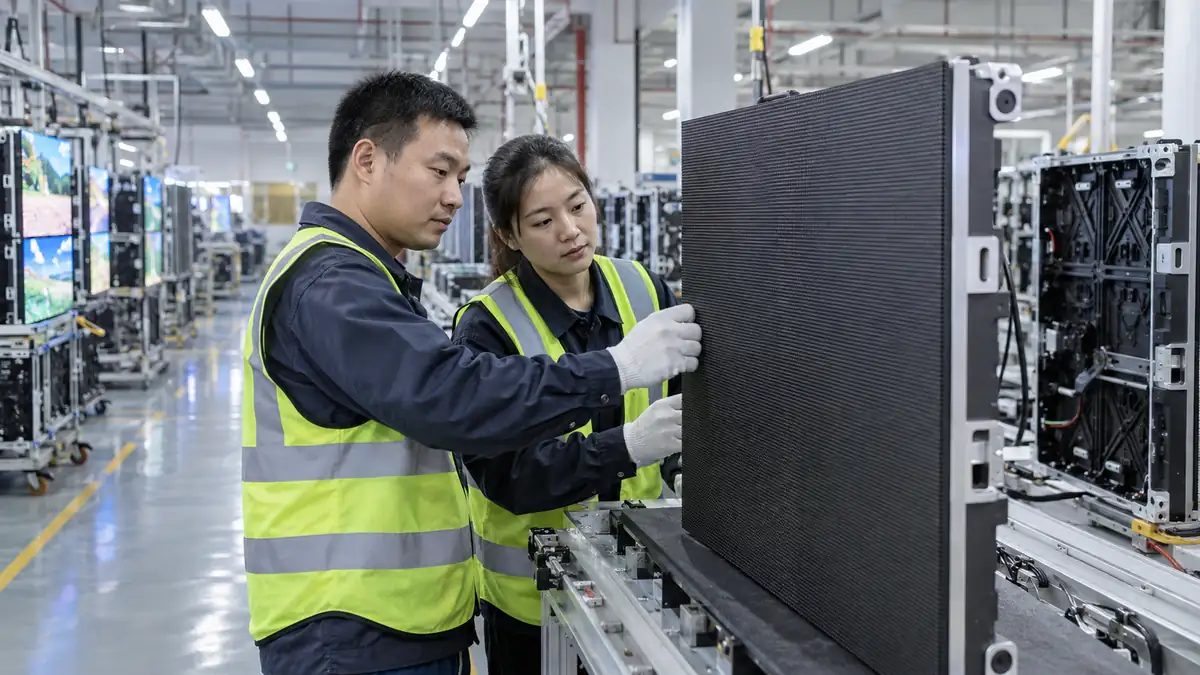
Choosing an LED display manufacturer in China is not primarily a price-comparison exercise. It is a risk-control decision.
The supplier you select will influence more than the purchase price. It will affect whether the screen matches the viewing distance, survives the installation climate, stays consistent across cabinets, arrives in the correct configuration, and can be repaired when a project is already in front of an audience, a client, or the public.
That is why a convincing website, a low quotation, or a long product list is not enough. A capable factory should be able to connect five things clearly:
- the application requirement;
- the engineering design;
- the manufacturing and inspection process;
- the export and installation plan;
- the support available after commissioning.
This is the standard we use when buyers evaluate LED Visual, and it is the standard we recommend to advertising agencies, event and exhibition companies, retail brands, public institutions, stadium operators, hotels, entertainment venues, and education or corporate-training organizations.
The best LED display factory is not necessarily the largest or the cheapest. It is the one that can demonstrate control over the risks your project cannot afford.
Start with the project, not the product catalogue
Before you compare factories, write a short project brief. A manufacturer cannot recommend a responsible display from screen size alone.
At minimum, define:
| Requirement | Why the factory needs it |
|---|---|
| Indoor or outdoor location | Determines brightness, sealing, thermal design, and cabinet construction |
| Closest and farthest viewing distance | Helps determine pixel pitch and content legibility |
| Fixed, rental, mobile, or creative installation | Changes cabinet weight, locking system, service access, and structural requirements |
| Camera, broadcast, or livestream use | Makes refresh rate, scan behavior, grayscale, and camera testing important |
| Local climate and exposure | Affects heat dissipation, waterproofing, corrosion protection, and brightness control |
| Tipo de contenido | Text, sports, advertising, live video, and fine graphics place different demands on the display |
| Maintenance access | Determines whether front service, rear service, or hybrid access is practical |
| Destination country and compliance needs | Influences documentation, electrical requirements, logistics, and import readiness |
| Delivery and installation deadline | Affects production scheduling, testing, spares, packing, and on-site support |
This short brief also exposes weak suppliers quickly. A factory that jumps straight to a price without asking about viewing distance, environment, content, and service access is not necessarily giving you an efficient quote. It may be quoting a generic product before understanding the application.
For background on how pixel pitch should be selected from real viewing conditions, see the LED display pixel pitch buyer’s guide.
The first test: can you verify that it is a manufacturer?
The distinction between a factory and a trading company is not a moral judgement. A good integrator or trading partner can be useful when you need local coordination or a multi-brand package. The problem is paying a factory-level price while receiving limited control over engineering, production, and warranty decisions.
Ask the supplier to show evidence that connects the company you are contracting with to the people and equipment making your display.
Qué hay que comprobar
-
The legal entity and manufacturing scope
The company name on the quotation, contract, invoice, and certificate should be consistent. Ask for the registered business information and confirm that its business scope supports the products being supplied. -
The physical production address
Request a live video tour or an in-person visit. A credible tour should show current production activity, not only a showroom. Ask to see receiving, assembly, testing, finished-goods storage, and packing areas. -
The engineering and production team
You should be able to speak with someone who understands cabinet structure, module compatibility, power distribution, receiving cards, control systems, thermal behavior, and service procedures—not only someone who can send a catalogue. -
The relationship between the factory and the product
Ask which parts are designed in-house, which are sourced, and which processes are outsourced. Outsourcing is not automatically a defect; hidden outsourcing is the risk. You need to know who controls the specification and who is accountable when something fails. -
A traceable sample
Ask for a sample cabinet or module that represents the proposed production configuration. The sample should not be an unrelated showroom product with different LEDs, power supplies, control cards, or cabinet materials.
At LED Visual, our Página «Quiénes somos» explains our Shenzhen base, production scope, product lines, export focus, and quality-control approach. The point of an about page is not to replace due diligence; it should make due diligence easier.
Evaluate engineering depth before manufacturing scale
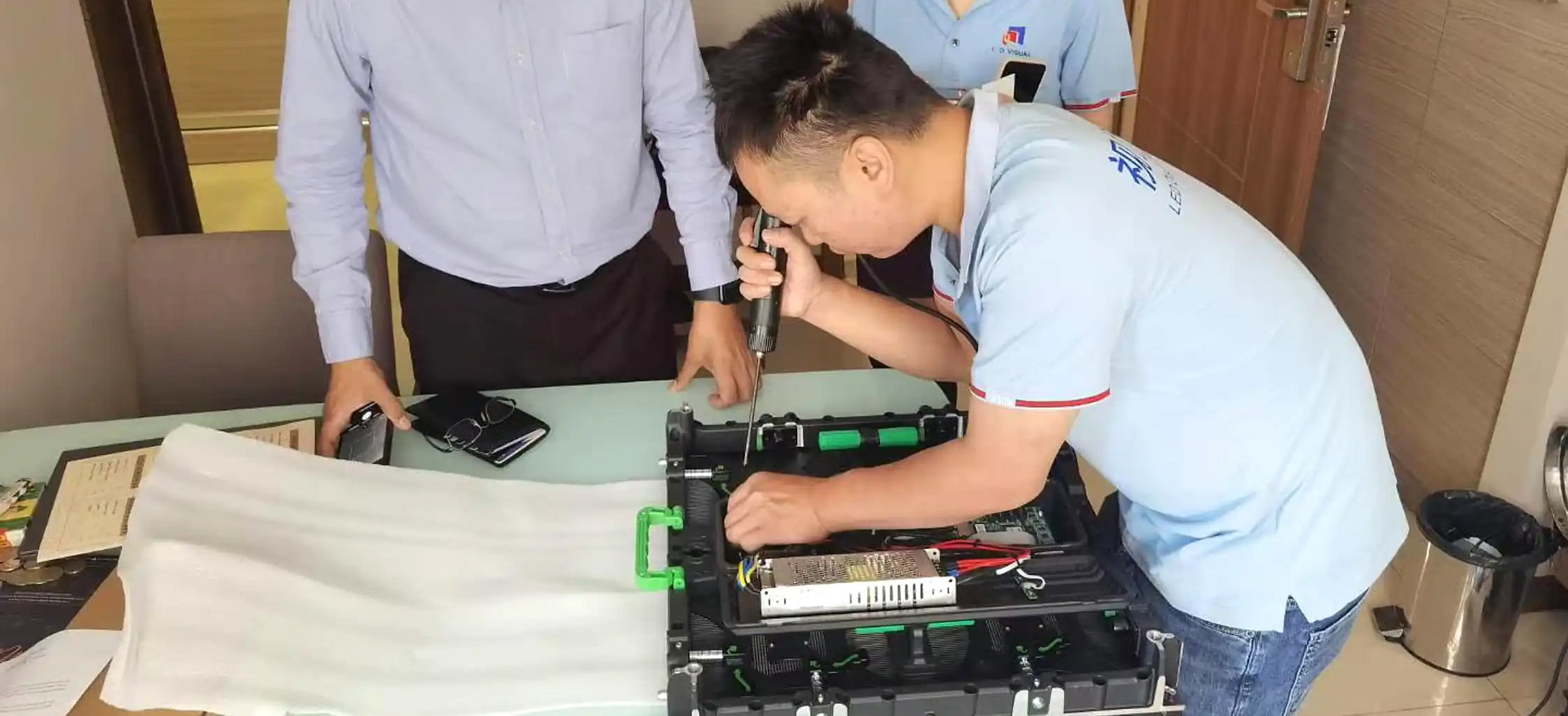
Manufacturing scale matters, but it is not a substitute for application engineering. A large catalogue can simply mean that a company sells many products. What matters is whether the supplier can adapt the display to your actual use case.
For an advertising and media company, that may mean brightness control, content scheduling, service access, and stable performance over long operating hours. For an event company, it may mean fast-lock rental cabinets, manageable weight, spare-part strategy, high refresh performance, and predictable setup. For a stadium operator, it may mean viewing-angle coverage, impact protection, broadcast-safe output, and maintenance that does not interrupt a match.
For a retail brand or hotel, the engineering question can be architectural: how will the screen fit a façade, atrium, window, curved wall, or premium interior without making the installation look improvised? For a government, education, or corporate project, clarity, reliability, documentation, and serviceability may matter more than maximum brightness.
Questions that reveal real engineering capability
- How do you select pixel pitch for our nearest viewing position?
- How will brightness be controlled throughout the day?
- What is the maintenance method for this installation?
- What happens if the display is exposed to heat, rain, salt air, dust, or high humidity?
- What refresh-rate and camera tests do you perform for broadcast or livestream use?
- How are cabinet dimensions, weight, load, wind exposure, and mounting interfaces coordinated?
- Which components are standardized for future replacement?
- Can you provide drawings, power information, signal-flow diagrams, and installation guidance before production?
The quality of the answers matters more than the number of technical terms. A professional manufacturer should explain the trade-offs in language your project, procurement, and installation teams can use.
Inspect the quality system, not only the finished screen
LED display quality is created through a chain of controlled decisions. It is not produced by a final visual inspection alone.
Ask how the factory manages:
- incoming LED modules, ICs, power supplies, receiving cards, cables, and cabinet materials;
- soldering, assembly, wiring, and mechanical alignment;
- module and cabinet testing before the display is packed;
- brightness, color, grayscale, and cabinet-to-cabinet uniformity;
- burn-in or aging procedures;
- serial numbers, batch records, and spare-parts identification;
- final inspection, packing protection, and shipment documentation.
You do not need every internal manufacturing document, but you should be able to see a repeatable system. A useful audit question is: “If one cabinet has a problem six months from now, how will you identify the affected part and reproduce the correct replacement?”
LED Visual’s public quality-control information describes raw-material traceability, inspection stations on production lines, and a unified quality standard across displays shipped from its facility. When reviewing any supplier, ask for the evidence behind similar claims: sample inspection records, test photos, serial-number logic, and a clear explanation of what is checked before shipment.
Certifications: treat them as evidence, not decoration
Ask for the actual certificate or test report, including the legal manufacturer name, model range, issue date, scope, and certificate number where applicable. Logos on a website are not enough.
Depending on the destination and product, buyers may need to review requirements associated with:
- CE marking and EU product compliance;
- RoHS restrictions in the European Union;
- FCC equipment authorization and compliance in the United States;
- IP Code protection classifications under IEC 60529, when ingress protection is part of the specification;
- any additional national or project-specific requirements.
Certificates do not prove that every future shipment will be identical to the tested sample. They do show whether the supplier understands documentation and whether the named product configuration has been evaluated within a defined scope.
Match the product family to the operating model
The right screen is determined by how the display will be operated, not by the product name alone.
Fixed outdoor displays
For billboards, building façades, roadside media, and public-space installations, review brightness, automatic dimming, waterproofing, corrosion resistance, heat dissipation, wind-load coordination, service access, and long-term spare availability. A high brightness figure is not a complete outdoor specification. The display must remain readable without creating unnecessary glare or heat.
Explore outdoor fixed LED display options when the screen is intended for permanent advertising or architectural use.
Indoor fine-pitch displays
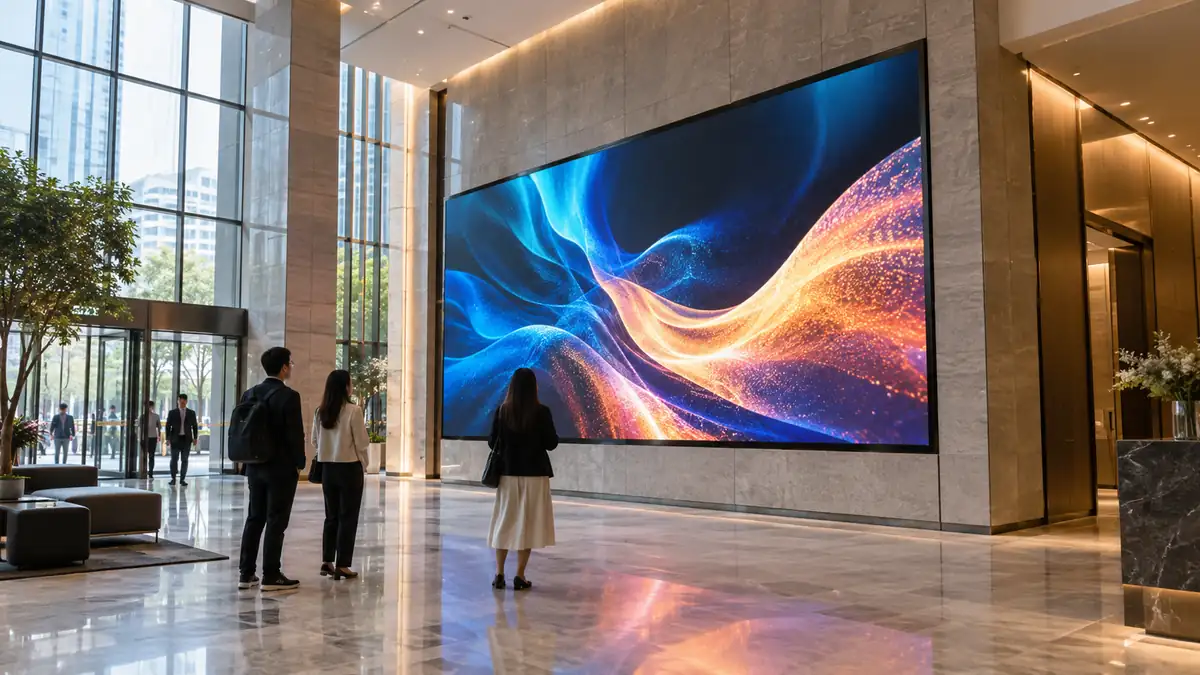
For corporate lobbies, control rooms, retail interiors, education spaces, broadcast environments, and premium hospitality venues, assess pixel pitch, close-range uniformity, grayscale, color calibration, noise, viewing angle, and service access. A smaller pixel pitch is not automatically better if the audience is far away or the installation budget is constrained.
Rental and stage displays
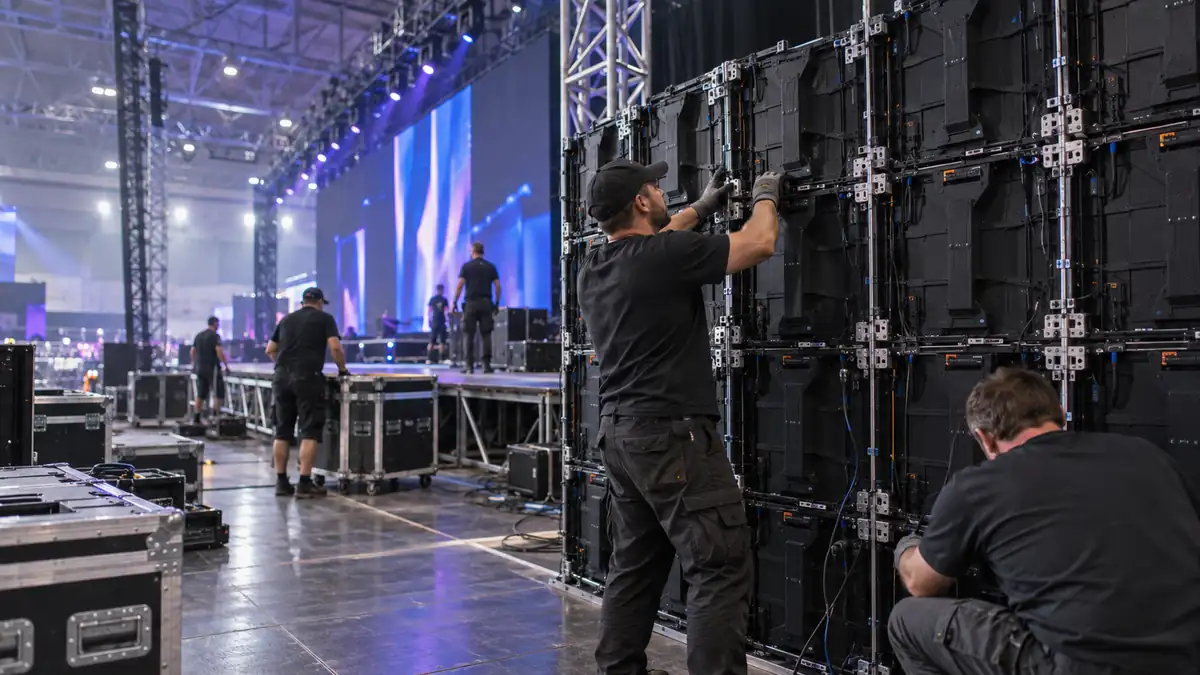
Event and exhibition companies should focus on fast assembly, cabinet weight, corner protection, locking reliability, repeatable cabinet geometry, high refresh performance, spare strategy, and the speed of technical support. The factory should understand that a rental fleet is an operating asset: every minute spent troubleshooting on site can affect crew cost, show schedules, and client confidence.
See the soluciones de pantallas LED de alquiler and the LED video wall rental guide for events and stages for related planning considerations.
Transparent, creative, and special-shape displays
Transparent, curved, cylindrical, flexible, dance-floor, and other creative products require more than a standard module placed in a new shape. Check how the manufacturer handles structural support, pixel alignment, content mapping, maintenance access, cable routing, thermal management, and replacement parts.
LED Visual’s complete product catalogue includes transparent, rental, stadium, taxi-top, floor-tile, cylindrical, and other product families. A broad catalogue is useful when it is supported by matching engineering knowledge.
Sports and broadcast applications
Stadium operators, broadcasters, and production companies should ask for camera tests rather than accepting “high refresh rate” as a vague promise. Review refresh behavior, scan lines, grayscale, brightness control, viewing-angle requirements, protective features, and control-system compatibility.
El stadium perimeter LED display page y sports and arena solutions are useful reference points when comparing the requirements of live sports environments.
Compare quotations by total project risk
Two LED display quotations may look similar while describing different products. Make the comparison structured.
| Quotation item | What to compare |
|---|---|
| LED configuration | Brand or grade, module size, IC type, scan mode, and stated performance |
| Gobierno | Material, dimensions, weight, flatness, locking system, service method, and protection features |
| Brightness and control | Maximum brightness, operating brightness, auto-dimming, and calibration method |
| Distancia entre píxeles | Whether it fits the closest viewer, content type, and camera plan |
| Sistema de control | Processor, sending and receiving cards, software, input formats, redundancy, and training |
| Potencia | Average and peak consumption, distribution, connectors, and site power assumptions |
| Testing | Aging, color calibration, cabinet testing, camera testing, inspection records, and acceptance criteria |
| Recambios | Recommended quantity, included parts, compatibility, lead time, and pricing after warranty |
| Packing and logistics | Crating, shock protection, shipment terms, insurance, customs documents, and delivery schedule |
| Asistencia | Warranty scope, remote diagnosis, replacement process, installation guidance, and escalation path |
Do not accept a quotation that hides important variables behind “standard accessories” or “best quality.” Ask the supplier to issue a final technical specification and a bill of materials that can be attached to the purchase contract.
The lowest initial quote can become the most expensive option if it creates extra installation labor, poor content performance, inconsistent replacement parts, or extended downtime. A better comparison is: what does each supplier do to reduce the probability and cost of failure?
Audit the factory before placing a large order
For a significant project, request a factory audit or live video audit before the deposit. The audit should be specific to your proposed product, not a general promotional tour.
Ask to see:
- the current production line for the relevant cabinet type;
- incoming-material inspection;
- assembly and wiring stations;
- aging or burn-in areas;
- calibration and final inspection;
- finished-goods storage and packing;
- spare modules and service parts;
- the engineering team responsible for your order.
Prepare a short question list and ask for the same evidence from every shortlisted supplier. If a factory refuses a reasonable live walkthrough, cannot identify the proposed product configuration, or gives different answers from sales and engineering, record that as procurement risk.
If travel is practical, visit the address shown in the contract and compare the company name, signage, production activity, and people you meet. If travel is not practical, use a live video call with time-sensitive requests such as showing a current date, the proposed cabinet, or a particular test station. The objective is not to stage a perfect factory tour. It is to test transparency.
Read the after-sales policy like an operator
Warranty length is only one line in a support plan. Ask what happens when the screen is installed in another country and a problem appears during a campaign, an event, or a public program.
Clarify:
- what is covered and what is excluded;
- when the warranty starts;
- who diagnoses the fault;
- whether remote support is available through the control system;
- how replacement modules and power supplies are identified;
- who pays shipping for confirmed manufacturing defects;
- what happens when a component is discontinued;
- whether installation guidance and commissioning support are included;
- how escalation works if the first response does not solve the problem.
LED Visual publishes a global support and warranty policy that describes two-year factory-backed coverage, remote technical support, calibration assistance, firmware support, and fault diagnosis. Buyers should use that type of page as a starting point, then make the final support terms specific in the contract.
The strongest supplier is often the one that can explain a failure-recovery process in practical detail: identify the faulty part, confirm compatibility, guide the replacement, restore calibration, and document the result.
Use project evidence carefully
Case studies are valuable when they reveal decisions, not just locations and attractive photographs.
For each relevant project, ask:
- Was the application similar to ours?
- What was the viewing distance and environment?
- Which product series and pixel pitch were used?
- How was installation and maintenance handled?
- What did the manufacturer customize?
- Can the supplier provide technical drawings, test evidence, or a reference contact where appropriate?
LED Visual’s case-study archive includes projects across outdoor advertising, corporate interiors, retail, hospitality, event production, stadiums, and fine-pitch applications. This range is more useful than a generic claim that a supplier “serves all industries,” because it lets a buyer compare the project logic, not only the final image.
However, case studies should support—not replace—technical verification. A display supplied for one climate, audience distance, or operating schedule may not be suitable for another.
A practical shortlist scorecard
Use a weighted scorecard before you request final pricing. The exact weighting should follow your project, but this structure is a useful starting point:
| Evaluation area | Suggested question |
|---|---|
| Application engineering | Did the supplier ask the right questions and explain trade-offs? |
| Product fit | Does the proposed product match the environment, audience, content, and operating model? |
| Manufacturing control | Can the supplier show production, inspection, traceability, and packing processes? |
| Quality evidence | Are the sample, test records, and certificates tied to the quoted configuration? |
| Delivery readiness | Is the production schedule realistic, documented, and linked to acceptance testing? |
| International capability | Can the supplier support your destination market, documentation, and logistics? |
| Serviceability | Are parts standardized, identifiable, replaceable, and available after delivery? |
| Communication | Do sales, engineering, and service give consistent answers? |
| Commercial transparency | Are specifications, exclusions, warranty, and payment milestones explicit? |
Then apply a simple rule: a low score in a mission-critical category should disqualify a supplier, even if the total score looks attractive. For a live event, service response may be critical. For a permanent billboard, weather protection and maintenance access may be critical. For a government or education project, documentation and long-term support may deserve more weight than a small price difference.
What a responsible factory should provide before production
Before you approve the order, request a project package that includes:
- final technical specification;
- cabinet layout and installation interface information;
- power and signal requirements;
- content and control-system assumptions;
- color and brightness expectations;
- acceptance-test plan;
- production and shipping schedule;
- packing list and spare-parts recommendation;
- warranty and support terms;
- named contacts for sales, engineering, and after-sales service.
This package creates a shared definition of “the product.” It also makes later conversations faster because you are discussing evidence and agreed requirements instead of recollections from a sales call.
Final opinion: choose the factory that makes risk visible
The most reliable LED display manufacturer in China is not the company that promises everything immediately. It is the company that asks precise questions, shows its work, documents its limits, and takes responsibility across the life of the project.
Use the following sequence:
- define the operating environment and audience;
- verify the manufacturer’s identity and production control;
- test engineering depth with real project questions;
- match the product family to the operating model;
- compare quotations line by line;
- audit production and quality evidence;
- contract the acceptance and support process before the deposit.
At LED Visual, we build full-color indoor, outdoor, rental, transparent, creative, stadium, and special-application LED displays from our Shenzhen operation for international buyers. If you are still defining the product, share the screen size, viewing distance, installation environment, content type, destination country, and timeline through our página de contacto. Our engineering team can recommend a suitable configuration and identify the decisions that need to be settled before production.
The right factory should make your project easier to operate—not merely cheaper to purchase.
Preguntas frecuentes
How can I tell whether an LED display supplier in China is a real factory?
Verify that the legal entity, quotation, certificates, production address, and contract are consistent. Request a live factory tour showing current production, testing, packing, and the product configuration you are considering. Also ask to speak with engineering, not only sales.
What certificates should an LED display manufacturer provide?
The answer depends on the destination and product. Ask for certificates and test reports tied to the quoted model, then review applicable requirements such as CE, RoHS, FCC, and IP protection classifications. Treat a logo on a website as a prompt for verification, not proof of compliance.
Is a lower LED display quotation usually better value?
Not necessarily. Compare cabinet construction, LED configuration, power, control system, testing, spares, packing, shipping assumptions, warranty, and service. A lower upfront price can create higher installation, downtime, replacement, or maintenance costs if the specification is incomplete.
Should I visit the LED display factory before ordering?
For a large or mission-critical project, an in-person visit is useful. If travel is not practical, request a live video audit with specific questions and time-sensitive evidence. The goal is to test transparency and verify that the proposed product is connected to the supplier’s actual production and engineering capability.
What information should I send when requesting an LED display quotation?
Include indoor or outdoor use, screen size, closest viewing distance, content type, camera requirements, installation method, destination country, climate, maintenance access, quantity, deadline, and whether the display is fixed, rental, mobile, or creative. A complete brief produces a more useful technical recommendation and quotation.