

In Digital Out-of-Home (DOOH) investment analysis, few metrics are as deceptively powerful — or as misleading — as Opportunity To See (OTS). A single LED billboard positioned at a major urban transit hub or along a highway is often marketed as a "golden medium" with 250,000+ weekly OTS. Yet according to data models published by Geopath und Route — the world's leading outdoor audience measurement bodies — those 250,000 physical vehicle and pedestrian passes, once adjusted through Visibility Adjusted Contacts (VAC), subconscious visual filtering, and final memory retention rates, translate to genuine brand impressions reaching only 1,000 to 6,000 people.
This cliff-like collapse from raw physical traffic to a tiny effective memory figure is typically blamed on mediocre creative execution. But as a professional LED display manufacturer with deep roots in hardware engineering, Visual LED has identified a long-neglected truth through extensive project data: the "invisible wall" blocking audience attention is, in most cases, caused by improperly configured underlying physical and optical specifications in the LED screen itself. Insufficient contrast producing washed-out imagery, low refresh rates generating scan lines in social media footage, and thermal design failures causing irreversible color shift and luminance decay — all of these silently erode the viewer's visual experience.
Evaluating the true commercial value and ROI of an outdoor LED billboard means cutting through opaque marketing language and zeroing in on the technical specifications that actually determine ad reach, visual fidelity, and long-term operational profitability.
1. Visual Visibility and the Physics of the Attention Funnel
Traditional static billboards are being rapidly phased out across the DOOH landscape. Static signs lack contrast and dynamic variation, making them poorly suited to capturing attention in fast-moving or information-saturated modern environments. Research demonstrates that DOOH advertising achieves 2.2× higher pedestrian recall than conventional static billboards, a result attributable to its high-dynamic, high-brightness physical characteristics. However, realizing that figure requires that the screen be capable of faithfully rendering high-fidelity content.
From OTS to VAC: The Evolution of Audience Measurement Currency
To precisely quantify the true reach of outdoor advertising, Geopath und Route have introduced Visibility Adjusted Contacts (VAC) as the industry-standard measurement currency. VAC makes clear that not every passerby constitutes a valid impression. The core factors influencing VAC include physical viewing angle, audience movement speed, distance and obstruction, and the screen's own brightness and contrast.
Route's eye-tracking research defines a 120-degree Cone of Vision. Only when an audience member falls within this cone und the screen's brightness is sufficient to compete with ambient light does that person register as having a Likelihood to See (LTS). Furthermore, the Dwell Time a viewer spends within the cone directly determines how deeply the ad message is decoded.
Modern audience dwell time on DOOH screens is trending shorter — from 4.6 seconds in 2014 to approximately 3.5 seconds today — with some high-traffic retail environments recording pedestrian gaze times as low as 1.2 seconds.
Within those few seconds, a screen's color accuracy, contrast transient response, and refresh rate become life-or-death factors for the advertisement. When a screen goes pale and washed out under direct sunlight, or when frame tearing appears during dynamic video, the human brain automatically triggers its visual filtering mechanism and classifies the stimulus as noise to be ignored.
2. Pixel Pitch and the Geometry of Viewing Distance
Pixelabstand — the center-to-center physical distance between two adjacent pixels, measured in millimeters — is the most direct determinant of an LED billboard's cost and physical spatial resolution. Smaller pitch means exponentially higher pixel density and finer close-range images, but also drives up per-square-meter costs of semiconductor components, driver ICs, and SMT assembly.
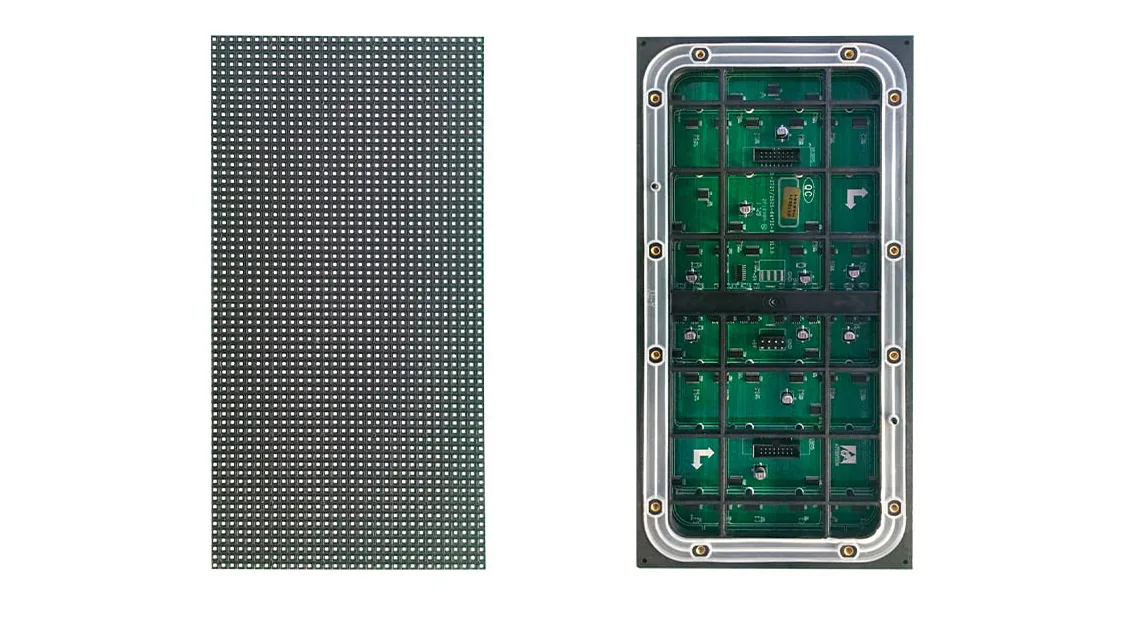
In practice, blindly pursuing ultra-fine pixel pitch is a serious capital misallocation. The human retina has a physical limit on angular resolution: when audiences are sufficiently far from the screen, P3 (3 mm pitch) and P10 (10 mm pitch) appear visually identical. The industry-standard "10× Rule" provides clear mathematical guidance for ROI across different audience scenarios:
Minimum Viewing Distance (meters) ≈ Pixel Pitch (mm) × 1
Optimal Viewing Distance (meters) ≈ Pixel Pitch (mm) × 2.5 to 3
To maximize the ROI on a display asset, hardware specifications must be precisely matched to the physical spatial characteristics of the target audience. The table below outlines optimal pixel pitch configurations for typical deployment scenarios:
| Target Audience / Application | Typical Location | Recommended Pixel Pitch | Core Display Requirements |
|---|---|---|---|
| Commercial Retail / Premium Tourism | Pedestrian mall storefronts, low-rise façades, interior lobbies | P1.5 – P2.5 | Pixel-invisible at close range (2–5 m), high color fidelity, near-OLED black level |
| Government / Transit / Sports Venues | City squares, transit hub info screens, low-rise signage | P3.9 – P4.8 | Sharp text edges at medium distance (5–15 m), high refresh rate for broadcast camera capture |
| Events / Performances / Large Retail | Building main façades, upper floors of large commercial centers | P6 – P8 | Medium-to-long viewing distance, high brightness for direct sun, balanced Total Cost of Ownership (TCO) |
| Highway Media / Large Landmarks | Highway columns (e.g., 14×48 ft format) | P10 – P16 | Ultra-long-distance legibility (100 m+), extreme brightness and weatherproofing; large pitch significantly lowers total screen cost |
For sports venue operators or large event companies, P3.9 to P6 is the sweet spot: it delivers crisp replay viewing for tens of thousands of spectators while keeping overall structural load under control. For media companies investing in highway networks, P10 to P16 paired with high-brightness modules is the optimal solution for recovering upfront construction costs of $150,000–$500,000 as rapidly as possible.
👉 Explore Visual LED's full range of outdoor display solutions — matched to every viewing distance and deployment scenario.
3. Contrast and Black Level: The Deep Logic of Fighting Ambient Light
A pervasive industry misconception in outdoor environments is "brightness supremacy" — the belief that maximum nits output is all that matters. While resisting direct noontime sunlight does demand exceptional brightness (typically 5,000–10,000 nits), the factor that truly determines image quality, text legibility, and color depth is contrast ratio.
Contrast ratio is the luminance ratio between the brightest white and the darkest black a display system can produce. A screen capable of outputting 8,000 nits of peak brightness but whose "black" under ambient light registers as milky gray (say, 0.8 nits due to mask reflectance and LED die base color) achieves only a true contrast of 10,000:1. If the black floor can be held at 0.2 nits in a dark scene, contrast undergoes a qualitative leap.
The Commercial Value of Static Contrast Ratio
Specification sheets frequently advertise Dynamic Contrast Ratio (DCR), which achieves theoretically astronomical numbers by modulating full-screen backlight output in real time. In practice, DCR introduces significant lag and distortion when handling fast-moving video or complex ads with rapid light-dark transitions. Professional buyers should focus on Static Contrast Ratio (SCR).
For outdoor direct-sun environments, a recommended SCR of 5,000:1 or higher is the target. Improving SCR is not a matter of simply increasing drive current — it depends on precision materials engineering:
- Matte Black Masks: Micro-textured black masks surrounding the LED emitters dramatically suppress both diffuse and specular reflection of incident sunlight.
- Black-Body LED Encapsulation: Premium outdoor screens use SMD emitters with black-body packaging, presenting an extremely deep black base when unlit. This fundamentally reduces ambient-light interference on dark pixels and resolves the color saturation collapse (red turning pink, blue turning gray) caused by insufficient contrast.
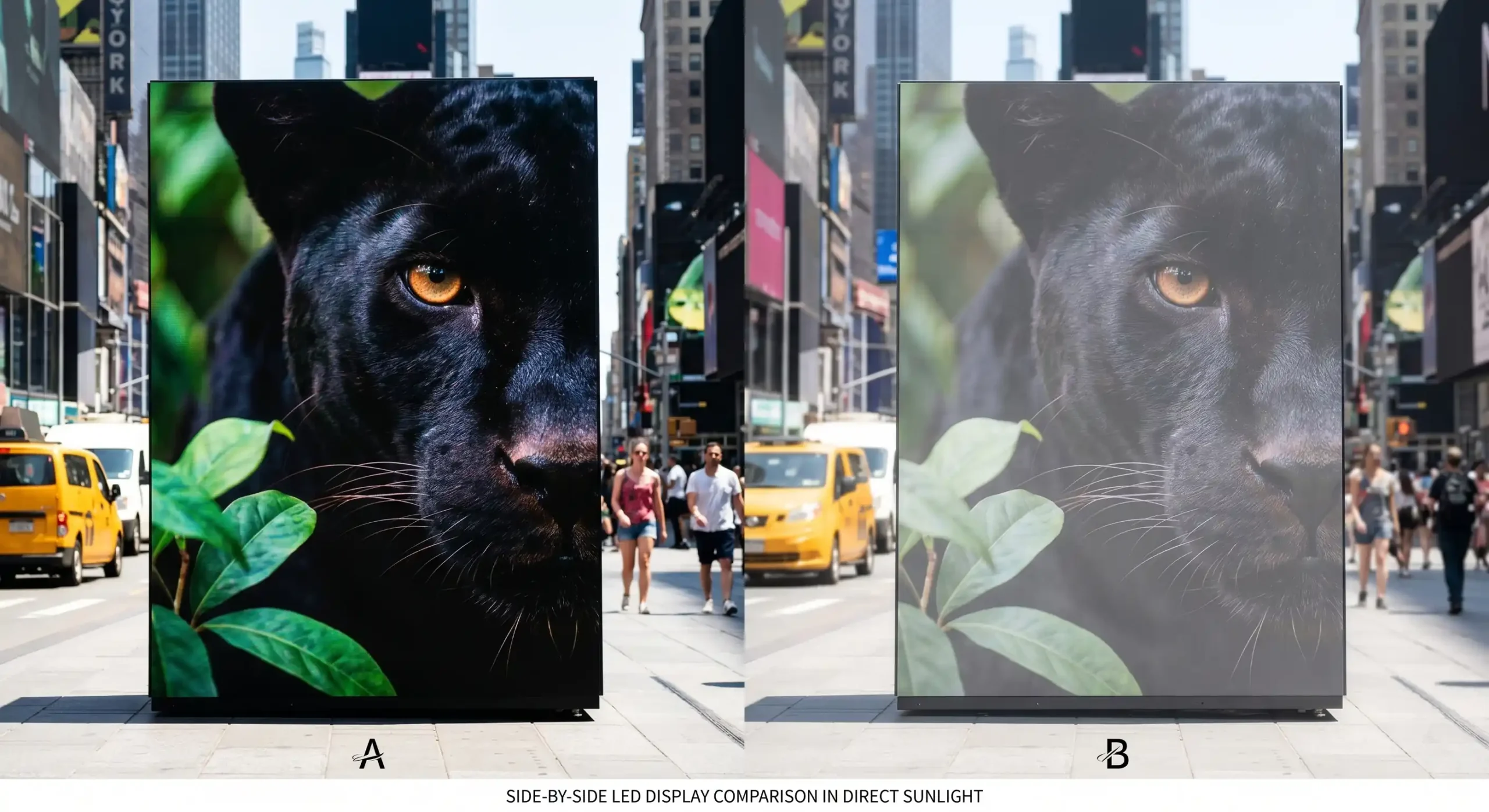
High contrast generates stronger perceptual depth. In highway settings — where audiences have only fractions of a second to decode information — high contrast effectively reduces Highway Blur, keeping text edges razor-sharp and dramatically boosting the instantaneous recall rate of brand logos and key messages.
Brightness Adaptation and Light Pollution Compliance
As DOOH networks expand globally, municipal zoning laws increasingly impose strict nighttime brightness limits on LED billboards. Bodies such as the Outdoor Advertising Association of America (OAAA) explicitly recommend that LED displays should not increase ambient illumination by more than 0.3 footcandles above existing environmental light levels.
Non-compliant screens face substantial fines or forced removal — and their excessive nighttime brightness creates glare that triggers visual aversion among viewers. Professional outdoor LED systems must incorporate high-precision photosensitive sensors paired with an ambient-light adaptive dimming control system. Such a system delivers full 10,000-nit peak output under noonday sun while smoothly transitioning to compliant brightness after dark — satisfying regulatory requirements and generating meaningful electricity savings over a 10–15 year operational lifecycle.
4. Refresh Rate and the Camera Trap: The Invisible Barrier of the Social Media Era
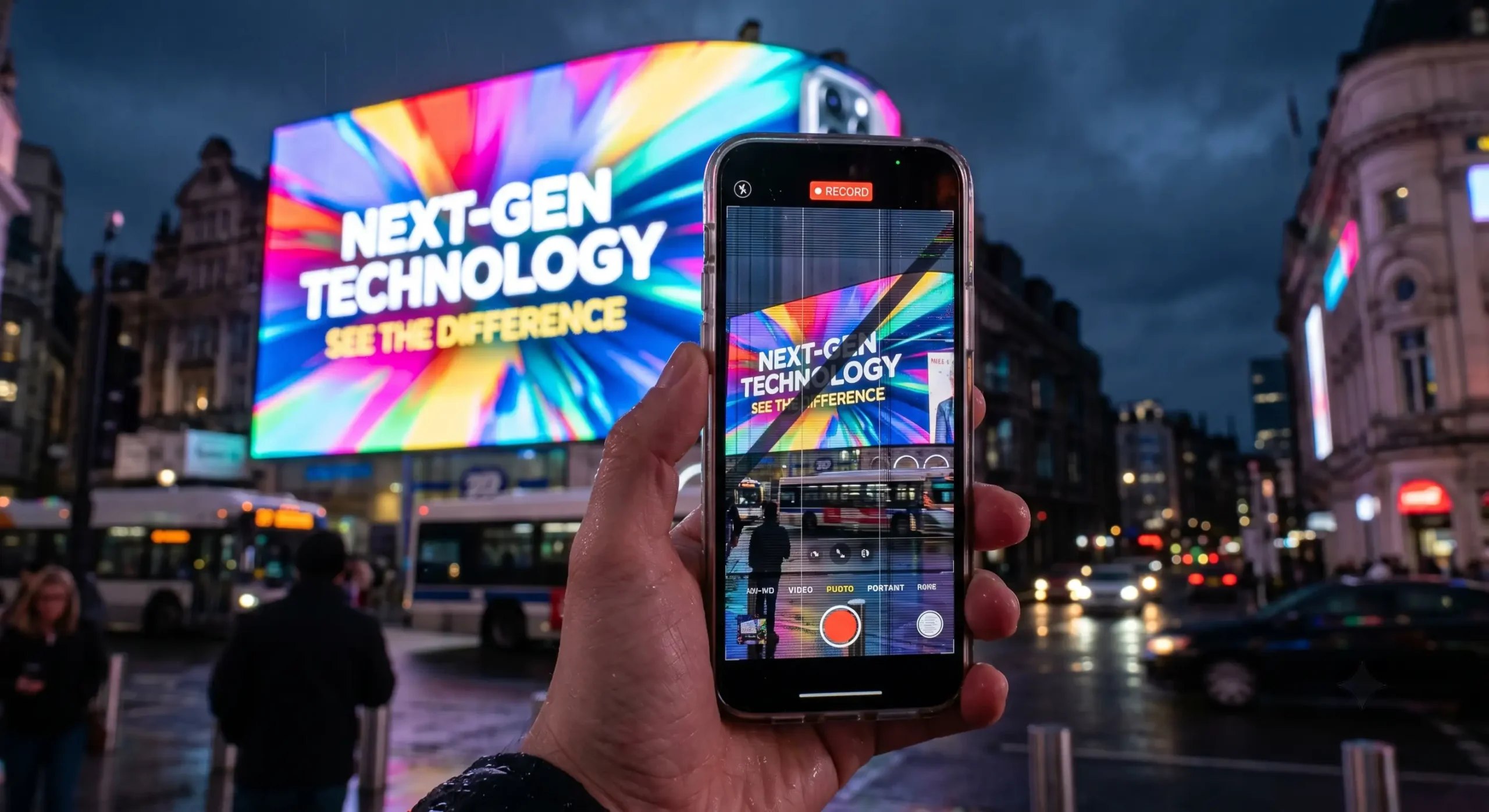
Modern brand marketing depends heavily on secondary amplification. A stunning naked-eye 3D outdoor ad receives most of its impressions not from pedestrians in the flesh, but from those same pedestrians filming it on their smartphones and uploading to TikTok, Instagram, or YouTube. Yet when a camera points at certain high-priced LED billboards, the footage is often marred by distracting horizontal black rolling bars (scan lines) or bizarre wave patterns (Moiré effect).
This phenomenon renders ad content illegible and severely damages the brand's visual credibility across digital channels. The core metric governing how a screen performs on camera is refresh rate and its underlying drive scan method.
PWM and the Physical Mechanism of Scan Lines
Bildwiederholfrequenz is the number of times per second an LED display redraws its image, expressed in Hz. Unlike conventional LCD panels that emit light continuously, LED screens use Pulse Width Modulation (PWM) to control grayscale and brightness — each LED emitter is actually switching on and off at very high speed.
For human visual persistence, a switching frequency above 1,920 Hz registers as a smooth, continuous image. But modern digital cameras and smartphones ubiquitously use Rolling Shutter sensors that expose the sensor line by line. When the camera's row-by-row scan timing overlaps with the dark-pulse phase of the LED's PWM cycle, the sensor records the LED in its "off" state, producing thick black bars across the video frame.
Nominal Refresh Rate vs. Effective Scan Frequency
A classic procurement trap: buyers assume that "3,840 Hz on the spec sheet" resolves all issues. In reality, two panels both rated at 3,840 Hz can perform radically differently on camera, because their scan modes differ fundamentally.
Most LED panels divide rows into groups — such as 1/8 scan or 1/16 scan — activated sequentially to reduce the number of driver ICs. The panel's Effective Scan Frequency equals the nominal refresh rate divided by the number of scan groups:
| Nominal Refresh Rate | Physical Scan Mode | Effective Scan Frequency | Camera-Safe Shutter Speed (no scan lines) |
|---|---|---|---|
| 1.920 Hz | 16-scan | 120 Hz | 1/120 s or slower |
| 1.920 Hz | 8-scan | 240 Hz | 1/240 s or slower |
| 3.840 Hz | 16-scan | 240 Hz | 1/240 s or slower |
| 3.840 Hz | 8-scan | 480 Hz | 1/480 s or slower |
| 3.840 Hz | Static Scan | 3.840 Hz | 1/1,000 s or slower |
| 7.680 Hz | 16-scan | 480 Hz | 1/480 s or slower |
A 3,840 Hz panel with a 16-scan architecture delivers only 240 Hz effective scan frequency. When captured by a high-speed sports camera shooting at 120 fps — or a smartphone auto-selecting a fast shutter in bright daylight (e.g., 1/1,000 s) — 240 Hz cannot cover the camera's ultra-short exposure window, and scan lines become inevitable.
For sports venue live broadcast screens, XR virtual production stages, and landmark screens in prime commercial districts with strong viral potential, deploying premium driver ICs with a Static Scan architecture or pushing refresh rate to cinema-grade 7,680 Hz is a mandatory specification to eliminate the barrier to cross-channel visual consistency.
👉 See how Visual LED's high-refresh-rate outdoor panels handle broadcast and social media capture with zero scan lines.
5. Structural Engineering and Protection Philosophy: Physical Armor Against Harsh Environments
An outdoor LED billboard is not only a precision optoelectronic device — it is an architectural attachment that must withstand extreme natural conditions. Investors typically focus only on the upfront purchase price, overlooking that a single water-ingress black-screen event costs not just expensive repairs, but also creates a gap in the Proof of Play (PoP) log, potentially triggering advertiser chargebacks and a crisis of confidence.
IP Protection Rating and Sealing Engineering
Professional outdoor LED systems must establish multiple layers of physical defense. Standard outdoor digital billboards require a minimum of IP65 (front) / IP54 (rear) ingress protection. In coastal highway environments with salt-spray corrosion, high-altitude installations subject to severe thermal cycling, or tropical cities with year-round torrential rain, IP65/IP66 or even IP68 fully-sealed aluminum or die-cast magnesium alloy cabinets are the baseline for sustained reliability.
To achieve outstanding thermal dissipation while completely blocking moisture ingress, premium modules apply high-efficiency polymer resin potting over their electronic circuits. This fully-encapsulating design provides military-grade moisture and dust resistance while rapidly conducting internal heat to the external metal casing — enabling 24/7 continuous operation without bulky air conditioning equipment.
For a full breakdown of IP rating standards, refer to the IEC 60529 enclosure classification system.
Structural Mechanics and the Economics of Maintenance Access
The all-in construction cost of a large outdoor billboard — including foundation, steel structure, permitting, and display hardware — typically ranges from $150,000 to $500,000 in 2025. The steel structure's cost is intimately tied to the maintenance access strategy chosen.
Traditional rear-service designs require a wide catwalk behind the screen, multiplying steel structure self-weight, demanding deeper foundations engineered against wind load and seismic forces, and proving simply infeasible on the façades of urban high-rises.
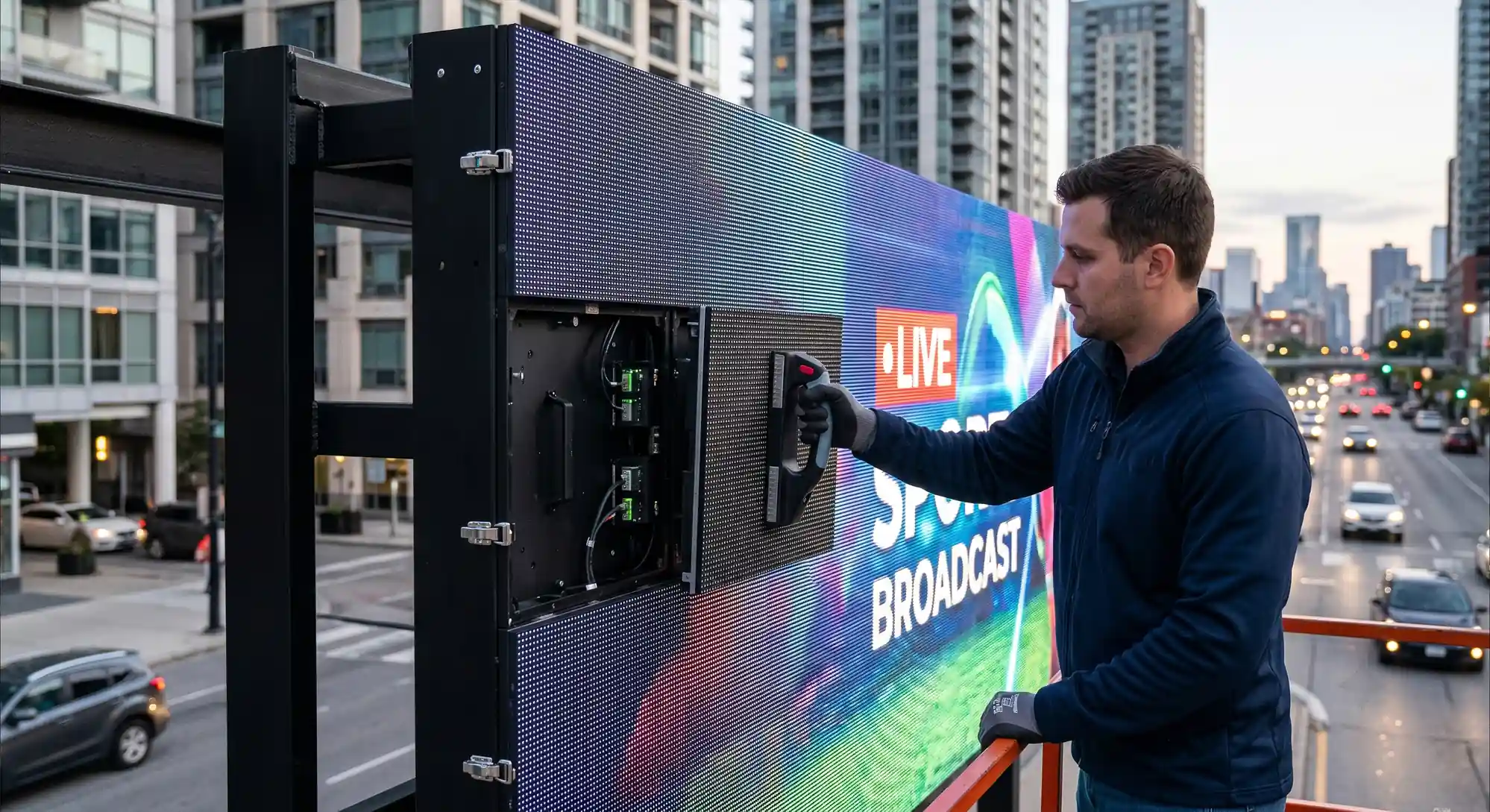
In modern DOOH networks, full front-service architecture has become the mainstream choice. Technicians using dedicated magnetic or mechanical tools can extract a faulty LED module or power supply from the front face in seconds, without damage. This design compresses screen thickness and steel structure cost to the minimum, and avoids the enormous labor costs and approval processes associated with deploying large cranes or closing major urban arterials.
Leveraging Visual LED's proprietary Easy Lock modular system, even the assembly and internal wiring of large-format screens becomes as intuitive as snapping building blocks together — fundamentally eliminating dependence on expensive outsourced maintenance teams and dramatically lowering Total Cost of Ownership (TCO) across the asset's lifecycle.
👉 Learn more about Visual LED's Easy Lock front-service technology and how it reduces lifetime maintenance costs.
6. Common Cathode Technology: The Energy Revolution Reshaping Profitability
When evaluating outdoor media investments, long-term operating expenditure (Opex) is the main artery of cash flow health. Traditional high-brightness outdoor LED screens are notorious energy consumers. Industry surveys indicate that a single large dual-sided digital billboard may consume as much as 115,000 kWh per year — enough to power dozens of average households.
Against this backdrop, the maturation of Common Cathode Technology is reshaping the entire outdoor advertising industry's economic model, emerging as the decisive force behind the sector's transition from high-energy consumption to green, sustainable operation.
The Underlying Physics of Common Cathode
In conventional manufacturing, most LED displays use a Common Anode design: the system supplies a constant voltage above 3.0 V uniformly to the red (R), green (G), and blue (B) LED chips that compose each pixel. Physically, however, red LED chips have a narrower bandgap and need only approximately 1.8–2.0 V to reach full brightness, while blue and green chips require 2.8–3.2 V or more.
In a common anode architecture, that excess voltage drop falls across the driver IC internals, being pitilessly converted into pure waste heat — squandering staggering amounts of electricity and driving PCB temperatures skyward.
Common Cathode architecture breaks this bottleneck. It restructures the circuit topology: the cathodes of all three color channels connect directly to ground, with precise voltage control delivered through independent dedicated anode channels. The system supplies red chips with under 2.8 V while routing higher voltages to green and blue — matched voltage for matched need, with zero waste.
Overwhelming Operating Cost Advantages
This precision in power management delivers compounding commercial advantages:
-
Direct Power Consumption Reduction of 50–60%: A standard P4 outdoor screen's average power draw can drop from 520 W per square meter (common anode) to below 430 W (common cathode). For a 50 m² screen running 16 hours per day, this represents tens of thousands of kWh saved annually — translating to tens of thousands of dollars in pure recovered margin at today's energy prices.
-
Thermal Stress Elimination and Luminance Decay Suppression: Eliminating waste heat reduces mean operating temperatures inside the cabinet by 6°C–10°C. This removes the need for expensive industrial air conditioning and cooling fan assemblies (further reducing BOM cost) and eradicates the Color Shift caused by uneven RGB luminance decay at high temperature — keeping the screen's color fidelity at factory-fresh standards across a 10-year lifecycle.
-
Dramatically Lower Failure Rates (Extended MTBF): Reduced thermal load greatly relieves physical stress on PCBs and solder joints. Field data shows that common cathode screens in high-temperature, high-humidity climates exhibit approximately 40% lower failure rates — meaning fewer field maintenance dispatches and lower parts replacement costs.
Although the initial procurement cost of common cathode driver ICs and their custom PCBs is typically 15–35% higher than conventional solutions, this "green premium" is fully recovered within 18–24 months of commissioning through electricity and maintenance savings. For large-scale outdoor media portfolio holders, this is a capital expenditure with near-certain returns.
👉 Explore Visual LED's common cathode outdoor display lineup and request a TCO comparison against conventional panels.
7. Software-Hardware Integration: Breaking Through Creative Fatigue and Programmatic Fraud
Outstanding hardware is merely infrastructure. The true driver of advertising returns is the software ecosystem that interfaces with it seamlessly. Today, over 53% of DOOH advertising is transacted through programmatic buying (pDOOH), and that share is growing rapidly.
Programmatic trading, however, introduces its own serious challenge. When a screen rotates through 6–8 different brands in quick succession, audiences easily develop Creative Blindness, causing the per-brand impression memory rate to plummet. To break through this barrier, the underlying hardware of a digital outdoor network must natively support an advanced Content Management System (CMS).
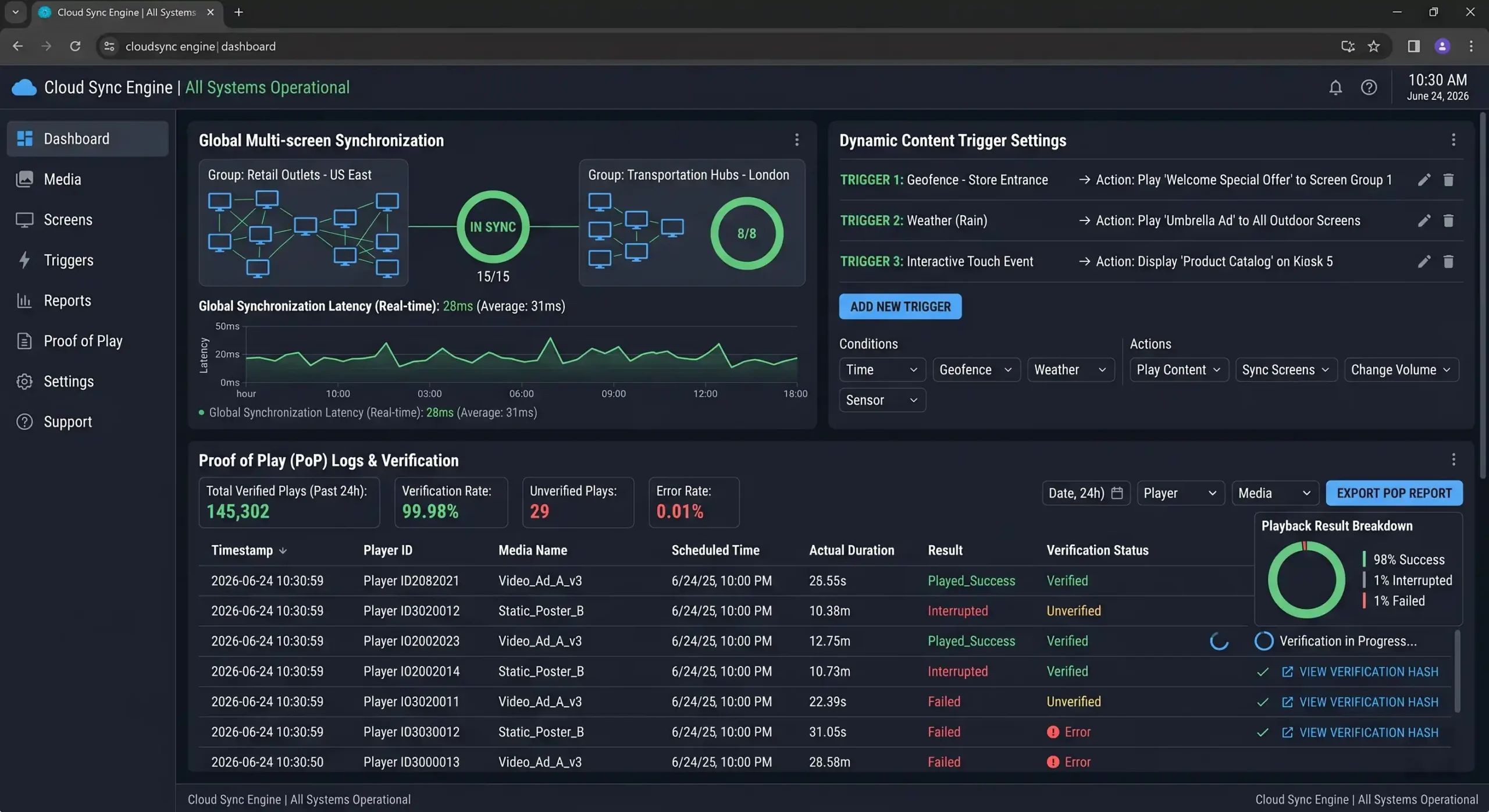
A professional cloud CMS must enable precise cross-screen synchronized playback and offer robust API interfaces for Dynamic Content Triggers with zero-latency rendering. For example:
- When a temperature sensor detects a sudden drop, the screen auto-switches from a cold-drink ad to a hot-coffee ad within 1 second.
- When sensors in a sports venue detect a home team goal, all surrounding LED screens simultaneously display the sponsor's celebratory animation.
This kind of contextually updated, high-relevance content effectively combats visual fatigue and pushes ad conversion rates toward their maximum.
Simultaneously, to combat ad fraud in programmatic trading and provide rigorous Proof of Play (PoP), LED controller cards must log genuine physical playback data — including real-time dead-pixel detection, voltage fluctuation feedback, and brightness status reporting. Only when physical screen data and cloud analytics achieve deep mutual trust can advertising media companies offer major brand clients a tamper-proof ROI audit trail.
Conclusion: Rebuilding the Foundational Moat of Outdoor Media
When building a modern digital outdoor advertising network, any decision to compromise on underlying hardware specifications will exact a 10× hidden cost in long-term operations.
From Geopath's VAC model to Route's visual tracking cone, the laws of attention in the physical world are brutally precise:
- A panel without high refresh rate (≥3,840 Hz, Static Scan) will become a scan-line-riddled visual liability in the social media era.
- A screen lacking black-body LED emitters and high contrast (≥5,000:1) will turn into a lifeless, gray-white pane of glass under the noonday sun.
- An operator who refuses to adopt common cathode energy efficiency und high-grade IP protection architecture will watch margins be steadily eroded by soaring electricity bills and endless maintenance work orders.
In this era of extreme attention scarcity and pervasive programmatic trading, an LED display is no longer merely a luminous carrier — it is the digital moat that determines the value of a media asset. For advertisers, commercial retailers, and venue operators committed to long-term value creation, the only path to transcending the traffic trap and maximizing genuine ad reach and asset profitability is to partner directly with a source-level LED display manufacturer with core R&D capabilities — one that can deliver a hardware ecosystem combining extreme weatherproofing, an advanced energy-efficient architecture, and cloud-intelligent control.
Ready to evaluate a specification-matched LED billboard investment? 👉 Contact Visual LED's engineering team for a customized technical consultation and full TCO analysis.